
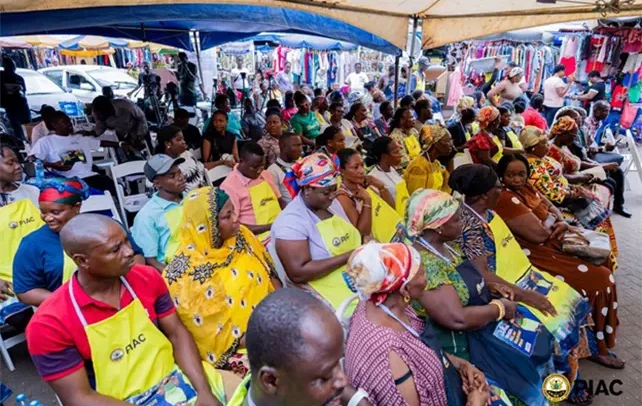
A section of the traders during the engagement
The Public Interest and Accountability Committee (PIAC), in partnership with the Africa Centre for Energy Policy (ACEP), last Friday engaged market women at Madina on the management and use of petroleum revenues.
The event, held at the Madina lorry station, brought together traders who sell various items from the Madina Main Market, Adenta Market, Bohye Market and surrounding communities.
The engagement formed part of PIAC’s community outreach programme to promote inclusivity and deepen public conversation on the management and use of petroleum revenues.
It also provided an interactive platform for the market women to learn, share their views and contribute to the national discourse on accountability and transparency in the use of revenue generated from the country’s natural resources.
The Chairman of PIAC, Richard Ellimah, in an interview with the media, said the engagement was part of the committee’s strategy to involve more Ghanaians in its work to ensure inclusiveness in national development.
He explained that PIAC had identified market women as one of the vulnerable groups that required targeted education on petroleum revenue management.
“First of all, it is very obvious that they have been marginalised. It appears nobody has engaged them to explain to them how petroleum revenues are used, and so there is a lot of ignorance about petroleum revenue,” he said.
“We are therefore happy that today’s engagement gave us the opportunity to explain and help them understand how petroleum revenue has been utilised since Ghana started oil production in December 2010,” he added.
According to him, PIAC will in the coming months extend similar engagements to other market centres, including Kaneshie, as well as reach out to other marginalised groups across the country, following the positive response from the Madina engagement.
He noted that evidence from the interaction showed that although petroleum revenues are national in nature, political actors, including District Assemblies, have not done enough to educate the public on how the funds are utilised.
The Vice Market Queen of Madina, Madam Theresah Ansong, commended PIAC for reaching out to the traders and educating them on petroleum revenue management, and called on the committee to extend the exercise to other market centres.
The market women, who expressed appreciation to PIAC for the engagement, also raised concerns about their inability to benefit directly from petroleum revenues in the form of soft loans to support their businesses since commercial oil production began.
By Ebenezer K. Amponsah