
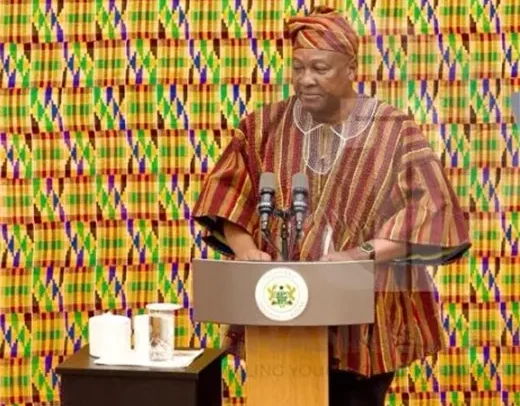
President John Dramani Mahama
The government has rolled out a package of interventions aimed at tackling youth unemployment, positioning skills development, industrial expansion and round-the-clock economic activity at the centre of its strategy.
President John Dramani Mahama, in his State of the Nation Address last Friday, outlined a multi-sector plan anchored on the 24-Hour Economy and Accelerated Export Development Programme, which he described as the boldest employment-generation initiative in recent years.
The programme, now backed by legislation following the passage of the 24-Hour Economy Authority Bill, seeks to unlock continuous economic activity across agriculture, manufacturing, logistics and services.
He said his government had allocated GH¢110 million in the 2026 Budget to kick-start implementation, with expectations that extended operating hours will stimulate production, attract private investment and create quality jobs for young people.
Beyond macroeconomic reforms, the President indicated that his administration was focusing heavily on skills acquisition.
According to him, six Regional Technical and Vocational Education and Training (TVET) Centres of Excellence will be constructed to equip young Ghanaians with industry-relevant competencies aligned with labour market demands.
Three new Technical Universities are also planned to expand access to practice-oriented tertiary education, while curriculum reforms are underway to align training with the OECD Future of Education and Skills framework, he added.
President Mahama said artificial intelligence, robotics and coding are being integrated into the basic education curriculum to prepare students for emerging sectors.
In agriculture, he asserted that youth employment is being driven through the National Service Agripreneur Programme, which has already enrolled thousands of young people.
He said the government is also recruiting 400 Feed Ghana District Coordinators and strengthening extension services through the distribution of motorbikes to officers nationwide.
President Mahama noted that the Poultry Farm-to-Table Project, targeting millions of birds annually through anchor farmers, SMEs and backyard producers, is expected to create jobs across the value chain while reducing Ghana’s heavy poultry import bill.
According to him, agro-processing facilities for rice, cashew, onion and soya are being developed to deepen value addition and stabilise farm incomes.
He stated that education financing reforms were also easing entry barriers, pointing out that the No-Fees-Stress Initiative had benefited over 150,000 first-year tertiary students, with projections exceeding 220,000 in the next academic year.
He said expanded student loan access and free tertiary education for persons with disabilities are part of efforts to widen opportunity.
The President emphasised that job creation cannot rely solely on the public sector. Instead, government aims to catalyse private-sector growth through partnerships with the Development Bank of Ghana and the Ghana Infrastructure Investment Fund to finance productive enterprises.
“Growth means nothing without inclusion,” he told Parliament, noting that over one million Ghanaians reportedly found employment between the first and third quarters of 2025.
By Ernest Kofi Adu, Parliament House