
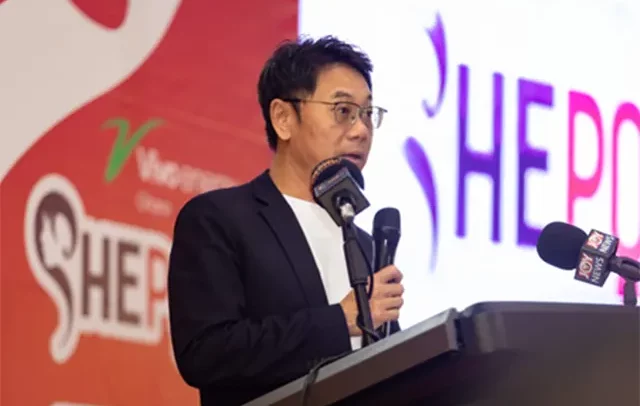
Christian Li addressing the participants
The third edition of the ShePower Summit has been held at the Kumaplay Auditorium of the College of Engineering at the Kwame Nkrumah University of Science and Technology (KNUST), bringing together more than 500 students, industry leaders and stakeholders to promote women’s participation in the energy sector.
The event, organised by Vivo Energy Ghana, formed part of activities marking International Women’s Day and focused on empowering young women in Science, Technology, Engineering And Mathematics (STEM) to take up opportunities within Ghana’s evolving energy landscape.
Held under the theme, “Empowering Women in Energy: Innovative Solutions for a Sustainable Ghana,” the summit featured a keynote address, expert panel discussions, student panels, innovation exhibitions and the launch of a new student innovation initiative.
Welcoming participants, Corporate Communications Manager of Vivo Energy Ghana, Shirley Tony Kum, said the ShePower initiative was created to open doors for young women interested in engineering and the energy sector.
She noted that the programme, now in its third year, has become one of the country’s most significant platforms connecting female engineering students with industry leaders, career pathways and opportunities within the energy industry.
According to her, the summit was particularly significant because it also witnessed the unveiling of the Next Generation Energy Innovators Challenge, a new initiative aimed at encouraging students to develop practical and innovative solutions to Ghana’s energy needs.
“As a company, our vision is to be Africa’s leading and most respected energy business, and ShePower reflects our commitment to building a sustainable talent pipeline, championing inclusion and shaping the future of energy through innovation and opportunity,” she said.
The keynote address was delivered by David Ato Quansah, Director of the Brew-Hammond Energy Centre at KNUST, who highlighted the critical role of innovation, research and collaboration in shaping Ghana’s sustainable energy future.
He encouraged students, particularly women, to take advantage of emerging opportunities in renewable energy, policy development and energy technologies as the sector undergoes rapid transformation.
Managing Director of Vivo Energy Ghana, Christian Li, also addressed participants and encouraged young women to take bold steps in pursuing careers in the energy sector.
He said the future of the energy industry depended on the creativity, courage and leadership of the next generation.
“Standing here today and looking at over 500 bright and determined faces, I am reminded of a powerful truth: you do not just have a space in the energy sector — the future of energy actually depends on you,” he stated.
Mr. Li explained that ShePower was established to create a platform where ambition meets opportunity, mentorship and access to career growth.
He added that diversity and inclusion remain central to the company’s operations, noting that women are contributing across the entire value chain of the organisation.
Representing the Vice-Chancellor of KNUST, Prof. Rita Akosua Dickson, a professor in the Department of Civil Engineering at KNUST, Kwaku Amaning Adjei, commended Vivo Energy Ghana for creating what he described as a powerful platform for empowering women in engineering and energy.
He said initiatives such as ShePower were important because they created visibility and mentorship opportunities for women who are shaping the future of the sector.
Prof. Amaning Adjei noted that although women have historically been underrepresented in engineering, the situation is gradually improving.
According to him, about 30 percent of students at the College of Engineering at KNUST are currently female, a figure he said continues to grow each year.
He emphasised that the future of energy must be inclusive, adding that the industry cannot move forward while leaving women behind.
Prof. Adjei also called for stronger collaboration between academia and industry, noting that universities nurture talent while industry provides the platform for innovation to translate into real-world impact.
He expressed optimism that the newly launched Next Generation Energy Innovation Challenge would encourage students to develop practical solutions to address Ghana’s energy challenges.
The summit also provided opportunities for networking, mentorship sessions and discussions aimed at inspiring young women to pursue careers in energy and engineering.
FROM David Afum, Kumasi