

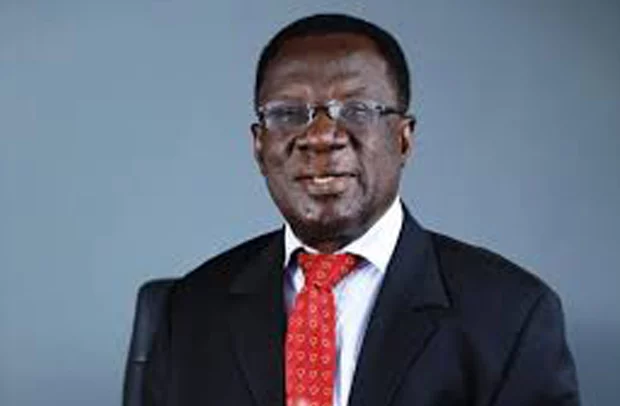
Prof. Ameyaw-Akumfi
A High Court in Accra has ordered Yaw Odame-Darkwa, the prosecution’s first witness in the trial of former Board Chairman and Chief Executive Officer of Ghana Infrastructure Investment Fund (GIIF), to evaluate and produce 16 email correspondences between him and other board members of the Fund.
The order follows the witness’ hesitation to use either his own phone or a court provided computer to log into his email account and access the emails dating back between July and September 2018.
Former Chief Executive Officer of GIIF, Solomon Asamoah and the erstwhile Board Chairman of the Fund, Prof. Christopher Ameyaw-Akumfi, have been charged before a High Court in Accra for their alleged involvement in unapproved $2 million investment in the Accra Sky Train project which allegedly resulted in financial loss to the state.
The prosecution’s first witness, Yaw Odame-Darkwa, in his testimony, had claimed that although a minutes from board meeting referred to the Sky Train project, the minutes do not accurately reflect the board’s deliberations or decisions concerning the Sky Train project at any time.
He also indicated that the Sky Train concept was only introduced at one of the board’s meetings, claiming that the board did not receive any substantive proposal on the project and, hence, it did not deliberate or take any decision on the project.
It was for this reason that Victoria Barth, counsel for Mr. Asamoah, introduced the emails between board members of the Fund, some of which were authored by the witness and mentioned the Sky Train project.
Yaw Odame-Darkwa, while under cross-examination, confirmed to the court that before board meetings were held to discuss new projects or existing projects, there would usually be a preceding meeting of the investment committee of the board of GIIF.
He also confirmed that the investment committee of which he was a member would usually receive an email notice from either the acting secretary Kofi Boakye, the CEO (Solomon Asamoah) or Harriet Aban, the substantive company secretary.
“These email notices would usually include the agenda and documents or board pacts for the upcoming meeting of the investment committee,” the lawyer asked and the witness answered “Yes.”
The witness also confirmed to the court that he has not deleted the email correspondences he received through his Gmail and Yahoo accounts during his time on the board of GIIF.
When confronted with one such email threads, the witness said they looked like one he received but would need time to verify same.
Yaw Odame-Darkwa turned down the opportunity to log into his email using his own mobile phone to evaluate the emails, saying he is not currently using that email address on his phone.
“If the first accused (Solomon Asamoah) is called upon to go into his email account on a device provided by the court with internet access right now and the emails are retrieved, would that help you confirm that you received these emails?” Victoria Barth pushed.
“In this era of AI (Artificial Intelligence), anything can be done. So, I’ll trust what I would retrieve from my own mail. That is why I’m asking the court to give me time to go through my personal email,” the witness rebutted.
Madam Barth further pointed out to the witness that time is of the essence and there are many emails to be shown to him, “so, it should be possible for you right here and right now to go on to that smart phone of yours and retrieve the emails in question. Is it not possible?”
But the witness said, “My Lady, it is not possible because I’m not using that email right now and I cannot access it now.”
The defence lawyer therefore, prayed the court to order the witness to access those emails with internet support that would be provided right in the courtroom through hotspot.
The request was opposed by Sefakor Batse, a Principal State Attorney, who said the witness who had already indicated that he could provide the emails at a later date, cannot be compelled to access them in the courtroom.
Justice Audrey Kocuvie-Tay, the trial judge, subsequently ordered the witness to access the emails and produce them on December 15, 2025, which is the next court date.
“To enable the witness do a comprehensive verification, I’m praying the court to order him to review and produce emails to the following dates in time,” Madam Barth said before going ahead to list 16 different email correspondences.
BY Gibril Abdul Razak