

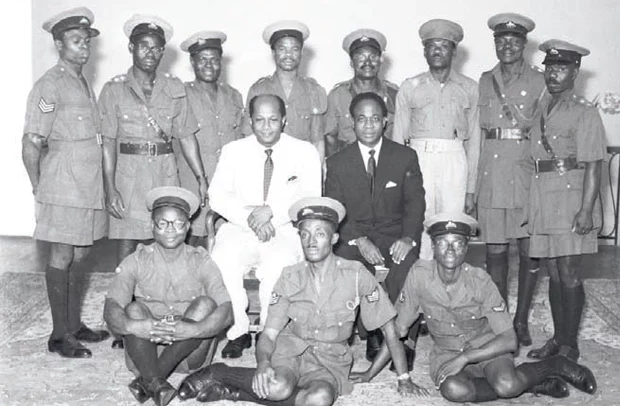
Kwame Nkrumah poses with his presidential police motorcycle riders
Sixty-nine years ago, the dream of the ‘Big Six’ and their compatriots came to pass and Ghana their beloved country, as an excited Kwame Nkrumah put it at the time, ‘is free forever.’
Many incidents preceded this landmark occasion, among them the boycott of European goods, the February 28, 1948 Osu Crossroads shooting incident and the looting that followed in Accra.
The foregone and the arrest and detention of Kwame Nkrumah expedited the granting of independence, which was symbolised by the lowering of the Union Jack, the British flag at midnight on March 6, 1957.
It marked the end of British colonial rule and the birth of the independent nation of Ghana.
The ceremony occurred at the Old Polo Grounds in Accra, at the place now housing the Kwame Nkrumah Mausoleum overlooking the Atlantic Ocean.
The excitement was electrifying, symbolising the end of over a century of colonial rule, 1874 to 1957.
The new flag of independence bore the colours red, green, and yellow horizontal stripes, with a black star in the centre.
The red represents the blood of our forebears who fought for the independence, the yellow, the gold resource of the country, and green the forests.
Kwame Nkrumah was a prominent figure in the independence struggle. Sometimes he is presented as the sole figure who fought and secured independence, a subject which often prompts historical arguments among scholars and politicians.
The “Ghana, your beloved country, is free forever” proclamation of independence which Kwame Nkrumah rendered at the Polo Ground in Accra remains a classic quotation in Ghanaian history.
Ghana’s independence provided the spark for a widespread agitation for similar status across colonial Africa.
While many welcomed independence, their expectations very high, others, especially the elderly, were not enthused about the transfer of power.
Events which followed independence were to prove the sceptics right.
…Portentous Signs After Independence
Fear began to grip Ghanaians when certain actions were taken by President Kwame Nkrumah in the first few years after independence.
Ghanaians, for instance, woke up on Thursday, January 1964 to the eerie announcement of the dismissal of post-independence first Commissioner of Police, Mr. Erasmus Ransford Tawia Madjitey.
Having earlier headed the Accra Police, his dismissal prompted questions and tongue-wagging as to the cause of the President’s action, especially when the action affected his two deputies and seven other senior officers.
For some, this was sign of the authoritarian traits the President was showing. A statement from the Office of the President and accompanying the action explained it thus “it was taken on the command of the President.”
The other senior officers affected by the President’s action were Mr. S.D. Amaning, Deputy Commissioner of Police; Mr. A.A. Tibo, Deputy Commissioner of Police; Mr. T.A. Adjirakor, Assistant Commissioner of Police; Mr. H.A. Nuamah, Assistant Commissioner of Police; Mr. S.B. Buta, Assistant Commissioner of Police; Mr. J.E. Quarm, Assistant Commissioner of Police; Mr. S.A. Amable, Assistant Commissioner of Police; T.W. Sackey, Assistant Superintendent of Police and Mr. M.K. Awuku, Superintendent of Police.
President Kwame Nkrumah appointed a replacement for the dismissed Mr. Madjitey in the person of Mr. J.W.K. Harley, then Assistant Commissioner of Police as the Acting Commissioner of Police. It should be noted that the rank of Inspector General of Police did not exist at the time.
Mr. Harley was to become a member of the junta which was established following the February 24, 1966 coup which ousted Kwame Nkrumah.
In yet another move, the President appointed two senior officers, Mr. B.A. Yakubu, then Superintendent of Police and Mr. A.K. Biney, also a Superintendent as Acting Deputy Commissioners, the first in the history of post independence Ghana.
Mr. Madjitey was born at Odumase Krobo on November 11, 1920 and educated at the Presbyterian Senior School, Bana Hill, Adisadel College and Achimota College.
He joined the Gold Coast Police Force in 1944 and promoted to the rank of Deputy Commissioner of Police on March 16, 1958. His elevation to the rank of Commissioner of Police in October 1958 made him the first Ghanaian to attain that rank.
This was the height of the Preventive Detention Act (PDA) which allowed for the arrest and detention of persons the President deemed threat to the state.
On Wednesday, January 9, 1964, government of course President Kwame Nkrumah issued a Preventive Detention Order against three persons, one of them Mr. S.D. Amaning, Deputy Commissioner of Police who had earlier been relieved of his position in the Police alongside Mr. E.R.T. Madjitey.
The other persons detained on the orders of the President were Dr. J.B. Danquah, then an Accra barrister and Mr. M.K. Awuku, Superintendent of Police.
At the time of his arrest, Dr. Danquah was 68. Efforts from many, including correspondences from the man while in prison to President Kwame Nkrumah, fell on deaf ears. He remained in the Nsawam Prison, his request to be taken to the prison hospital declined, until his death in the prison.
Fear gripped Ghanaians who wondered what laid ahead of the country when arrests became rampant and the courts disregarded in the scheme of things.