
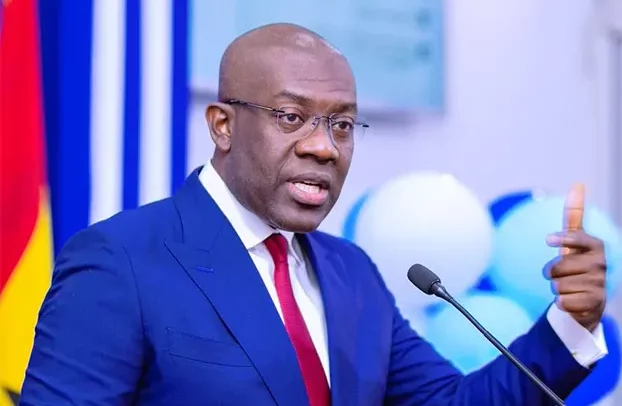
Kojo Oppong Nkrumah
A fresh controversy has erupted over Ghana’s reserve management strategy after Kojo Oppong Nkrumah, the Minority Member of Parliament for Ofoase-Ayirebi and Ranking Member on the Parliamentary Committee on Economy and Development, criticised the Bank of Ghana over its decision to sell part of the country’s gold reserves.
His comments followed a briefing by the Governor of the Bank of Ghana, Dr. Johnson Pandit Asiama, who appeared before the committee on Monday to explain the central bank’s monetary policy actions, reserve management decisions and the financial implications of stabilising the economy after the recent debt crisis.
Gold Accumulation Strategy
Over the past few years, Ghana has significantly expanded its gold reserves through the Domestic Gold Purchase Programme, introduced to strengthen the country’s external buffers and diversify its international reserve assets.
Before the programme began in 2021, the Bank of Ghana held approximately 8.7 tonnes of gold. Through sustained purchases from domestic producers, the central bank increased its gold holdings to over 40 tonnes by October 2025, making gold one of the largest components of Ghana’s reserve portfolio.
However, global gold prices surged sharply in 2025, rising by about 62 percent between January and October, which pushed gold’s share of the reserves to roughly 42 percent. According to the central bank, this raised concerns about excessive concentration risk in a single asset class.
BoG’s Explanation
Addressing lawmakers, Governor Dr. Asiama defended the Bank’s decision to rebalance its reserve portfolio by converting part of its gold holdings into foreign exchange assets.
He emphasised that the action did not represent a depletion of the national reserves but rather a strategic adjustment of their composition.
“Ghana’s gold reserves remain fully part of our international reserves; what changed was the composition of those reserves,” the Governor told the committee.
“The foreign exchange obtained from the transaction remains fully invested as part of the international reserves and continues to generate returns.”
Opposition Questions The Decision
However, Kojo Oppong Nkrumah strongly challenged the Bank’s explanation, arguing that the sale of about 18 tonnes of gold had resulted in a substantial opportunity cost for the country.
According to him, the gold was sold at a price of about $4,000 per ounce, whereas current global prices have risen to above $5,000 per ounce.
Based on these price differences, he explained that the country had effectively lost a potential $1.3 billion in valuation gains.
“The poor policy decision on portfolio rebalancing is what has led to the $1.3 billion loss on the sale of the 18 tonnes of gold,” he said after the committee meeting.
While acknowledging the importance of diversification in reserve management, Oppong Nkrumah argued that the central bank could have pursued alternative strategies to reduce concentration risk without selling the gold.
Disagreement Over Gold Price Forecasts
The Ranking Member also rejected the Bank’s suggestion that the surge in gold prices could not have been predicted.
He maintained that global market forecasts had already pointed to rising gold prices due to geopolitical tensions and global economic uncertainty.
“As far as we are concerned, most forecasts suggested that gold prices were going to rise in the medium term because of uncertainties around the world,” he said.
He, therefore, described the Bank of Ghana’s claim that the price increase was unforeseeable as unacceptable.
Mr. Oppong Nkrumah argued that if the central bank had retained the gold instead of selling it, Ghana’s reserves would have recorded a valuation gain of about $1.3 billion.
Parliament Signals Possible Inquiry
The legislator also disclosed that during the committee meeting, the Bank of Ghana acknowledged it had already assessed the valuation gains associated with the transaction and promised to provide details of that analysis to Parliament.
However, he said this disclosure does not preclude the parliamentary inquiry already requested by the Minority.
He further revealed that the central bank confirmed to the committee that the government approval was obtained before the gold sale was carried out.
According to him, lawmakers will now examine who authorised the transaction and whether such a significant decision should have been subject to parliamentary oversight.
“It is now turning out that they got approval from government before they sold it. We will be looking into who gave that approval for such a significant transaction without recourse to Parliament,” he said.
Reserve Management
The dispute reflects a growing debate about how Ghana manages its international reserves at a time when the country is rebuilding economic stability following a period of high inflation, currency depreciation and debt restructuring.
While the Bank of Ghana insists the gold sale was a standard reserve diversification strategy aimed at strengthening liquidity and resilience, the Minority argue the timing of the transaction may have deprived the country of significant potential gains.
However, with Parliament now signalling possible further scrutiny, the gold reserve transaction could become one of the most closely examined economic policy decisions in the recent financial history under the current NDC administration led by President John Dramani Mahama.
A Daily Guide Report