
Seth Emmanuel Terkper
Former Finance Minister, Seth Emmanuel Terkper, has stressed that external financing remains essential to the country’s development agenda, arguing that Ghana cannot rely solely on domestic revenue to fund its long-term economic transformation.
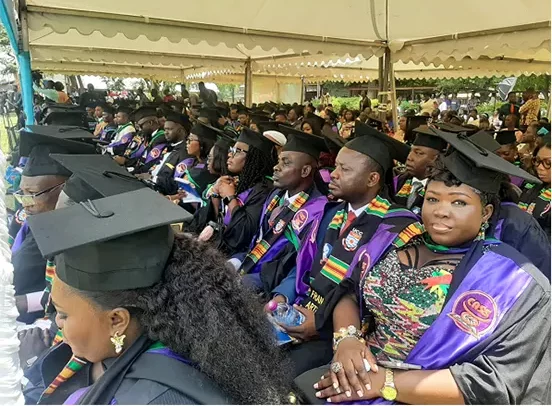
Speaking at the 11th graduation ceremony of Christ Apostolic University College (CAUC) at Kwadaso over the weekend, the former Finance Minister, who is also a Special Advisor to the President on Finance, said many developing economies face a widening gap between internal revenue generation and the resources required to finance large-scale infrastructure and social programmes.
According to him, borrowing from international financial markets and multilateral institutions remains a practical option for countries seeking to accelerate development.
“It is nearly impossible to finance the level of development Ghana requires without tapping into international markets,” he said, adding that such funding complements domestic revenue mobilisation efforts rather than replacing them.
Mr. Terkper noted that even advanced economies continue to rely on external borrowing to sustain long-term investment projects. He cited examples such as the United States and France, which regularly raise funds through global capital markets to support infrastructure and public spending.
He explained that Ghana must continue engaging international institutions, including the World Bank and the International Monetary Fund (IMF), to bridge the financing gap between domestic revenue and the country’s development needs.
However, he emphasised that access to such financing depends largely on sound economic management and fiscal discipline.
Mr. Terkper said the John Dramani Mahama administration is committed to strengthening financial governance and moving beyond political rhetoric towards prudent economic management that inspires confidence among development partners and investors.
He explained that the government’s economic strategy focuses on building credible institutions that meet international lending standards, directing borrowed resources towards high-impact development programmes, and promoting accountability in the management of public finances.
These measures, he said, are critical to ensuring that borrowed funds translate into tangible development outcomes and support a sustainable economic recovery.
Touching on the theme of the graduation ceremony, “Sustainable Minds, Sustainable Leadership for a Greener Tomorrow,” Mr. Terkper linked economic development to environmental sustainability.
He commended CAUC for promoting environmental awareness among its students and highlighted government initiatives aimed at protecting the country’s natural resources.
Among them, he mentioned the Green Ghana Initiative, which promotes nationwide tree planting, and renewed efforts to combat illegal mining (galamsey) in the country, a practice widely blamed for the degradation of forests and water bodies.
“Beyond reforestation, we are tackling activities like galamsey that threaten our collective livelihoods. We are taking rigorous measures today to ensure that future generations inherit a viable environment,” he said.
The ceremony saw a total of 188 students graduating from the university.
President of CAUC, Professor Geoffrey Emi-Reynolds, reaffirmed the institution’s commitment to producing professionals who combine academic excellence with strong moral and spiritual values.
He explained that the university’s programmes are designed to prepare students for the demands of the modern job market while nurturing character and discipline.
The Chancellor of the university, Apostle Samuel Amponsah-Frimpong, also urged the graduates to apply the knowledge and values they have acquired to positively impact society.
He reminded them that the institution was founded on the principle that academic excellence must go hand in hand with spiritual integrity and service to humanity.
During the ceremony, solidarity messages were delivered by representatives from the Kwame Nkrumah University of Science and Technology and the University of Cape Coast, who congratulated the graduates and encouraged them to contribute meaningfully to national development.
The university also honoured several long-serving staff members, including George Sarfo Nketiah, in recognition of their dedicated service to the institution.
Delivering the valedictory address, the overall best graduating student, Ebenezer Kofi Sekyi, expressed gratitude to the university’s management and lecturers for creating an environment that nurtured academic and personal growth.
He urged his fellow graduates to uphold the values of the university as they step into professional life and contribute to building a better society.
By Ernest Kofi Adu