
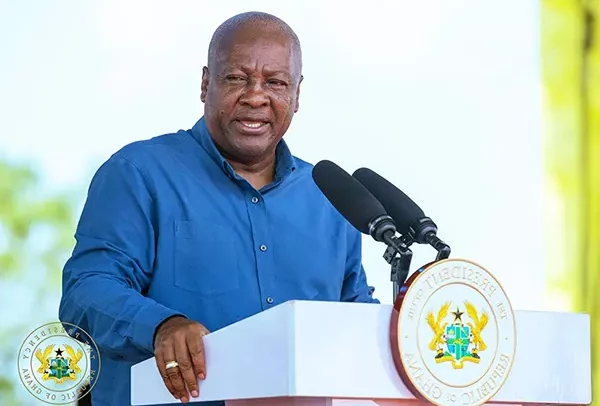
President John Dramani Mahama
President John Dramani Mahama has called on Ghanaians to adopt healthier eating habits and more active lifestyles to curb the growing burden of Non-Communicable Diseases (NCDs) in the country.
Speaking at the launch of the Free Primary Healthcare Initiative in Accra, the President expressed concern over changing dietary patterns and sedentary lifestyles, which he said are contributing significantly to the rise in conditions such as hypertension, diabetes, and heart disease.
President Mahama criticised the tendency to consume large portions of heavy foods such as banku and fufu late at night, particularly among people who lead sedentary lives, warning that such habits pose serious health risks.
“If you are the kind of person who likes eating heavy foods, you are not physically active, you are sitting at one place and yet when they give you your fufu or banku, you say it’s too small. You want a big bowl of fufu and you want to eat it every day,” he said.
He further advised against late-night eating, urging citizens to finish dinner early to aid proper digestion and overall health.
“Sometimes you eat it at night before you go and sleep. Please by 7PM, eat your dinner and don’t eat again. If you are hungry, just pick some cup of tea or something. Don’t eat any heavy food,” he cautioned.
The President also highlighted the stark contrast between modern lifestyles and those of previous generations, noting that while traditional foods like banku were commonly consumed in the past, people were far more physically active.
“Our fathers used to eat banku and co in the night but they were physically active. They used to go to the farm and they expended energy. Now we don’t do any physical activity. You wake up in the morning, eat breakfast, drive to work, sit behind the desk from 8 am to 5 pm, drive back home, and when you come home you ask for your banku. What physical activity did you do to deserve banku?” he quipped.
President Mahama stressed that addressing NCDs requires not only access to healthcare but also a shift in personal lifestyle choices.
He urged the public to embrace regular exercise, balanced diets, and mindful eating habits as part of a broader national effort to improve health outcomes.
On the Free Primary Healthcare Initiative, the President explained that the government’s Free Primary Healthcare Policy is designed to support, not replace, the National Health Insurance Scheme (NHIS).
According to him, the primary healthcare services under the initiative will be provided at no cost to patients at the community level.
President indicated that basic screening and treatment for common illnesses such as malaria and cholera would be handled at Community-based Health Planning and Services (CHPS) compounds without any charge.
He added that patients would only be referred to higher-level facilities when necessary.
“The Free Primary Healthcare complements the National Health Insurance and so at that level it is free of charge,” he stressed.
By Ernest Kofi Adu