
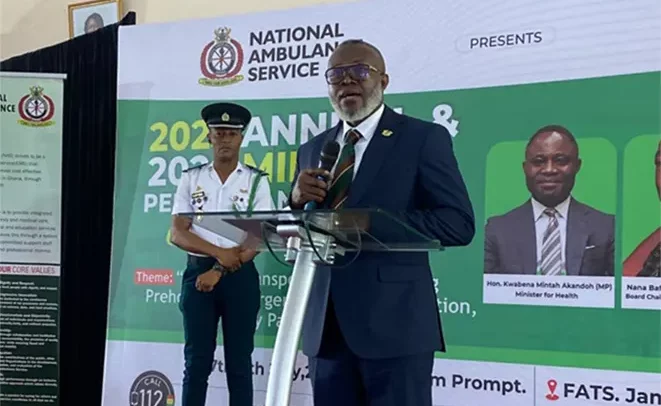
Dr. George Kojo Owusu
THE CHIEF Executive Officer of the National Ambulance Service (NAS), Dr. George Kojo Owusu, has called on motorists, especially public transport drivers, to make way for ambulance vehicles to ensure timely response to emergencies.
Speaking at the 2025 Annual and 2026 Mid-Year Review Meeting of the National Ambulance Service, Dr. Owusu said navigating through traffic in congested cities like Kumasi and Accra remains a major challenge for emergency teams.
“For many years, ambulances were largely perceived as vehicles for transporting patients from one location to another. Today, however, emergency medical care has evolved significantly,” he said. “Even when our lights are on with sirens blaring, it is still very difficult for drivers to give way. But any time you hear the sound of an ambulance siren and see the flashing lights, please request right of way. That patient could be your father, your mother, or your relative. It may be you tomorrow,” Dr. Owusu stressed.
The NAS CEO disclosed that demand for ambulance services has witnessed a 4.6% growth, putting more pressure on the Service to improve response time. “This means we have to be up to the task. People are now aware that they need ambulances, so we must ensure more of our fleet is available, our staffs are up to date with their medical skills, and we improve on response time,” he stated.
He added that President John Mahama has directed that “no person in Ghana will die because an ambulance failed to come,” and the Service is working to meet that directive.
Dr. Owusu also announced a new initiative by the Ministry of Health, to roll out a National Integrated Bed Management System. The system will provide real-time visibility of available beds at receiving and referring facilities, allowing ambulance crews to know where to send patients before they set off.
“This will prevent what we call ‘no bed’ situations. Before we even leave, we will know precisely where we are going. I believe when we roll this out, our system will be second to South Africa in Africa. It is a very good initiative that we must all support,” he said.
Dr. Owusu said the National Ambulance Service is leading a transformation in emergency care in Ghana. “Our vision rests on three critical pillars: strengthening prehospital emergency care, stabilisation, and timely patient transfer. We remain committed to investing in continuous professional training, equipping our ambulances with modern life-saving equipment, strengthening dispatch and referral systems, and working closely with hospitals and partners to ensure every Ghanaian receives quality emergency care regardless of location,” he added.
He urged the public to treat ambulances as priority vehicles on the road, noting that seconds saved can mean the difference between life and death.
By Prince Fiifi Yorke