
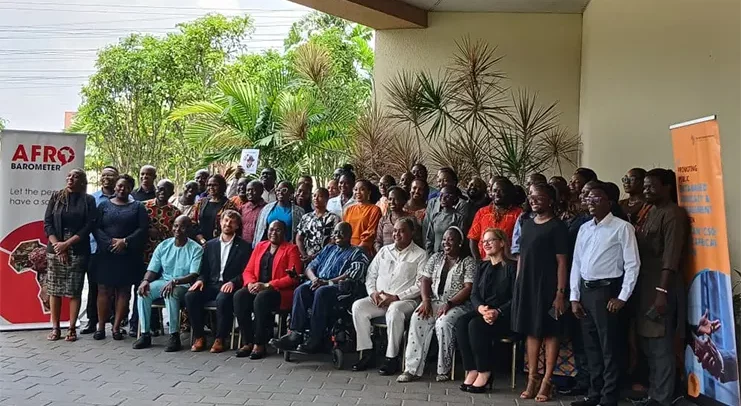
Participants present at the meeting
Afrobarometer has hosted its first-ever Data for Governance Alliance (D4GA) continental convening in Accra.
The meeting brought together stakeholders across Africa to reflect on democracy, governance and human rights while strengthening the role of data in shaping policy and accountability on the continent.
Speaking at the meeting, the co-founder of Afrobarometer, Prof. E. Gyimah-Boadi, mentioned that data in the hands of African civil society is a powerful instrument for change.
He stressed that civil society has been the connective tissue of Africa’s democratic journey, adding that civil society is the space where citizens organise, deliberate, and hold power to account between elections.
He indicated that Africa’s continental governance architecture captured in the African Union’s Agenda 2063 and the African Governance Platform expresses an ambitious vision of a people-centred, prosperous, and peaceful continent, noting that the Data for Governance Alliance aims to address three critical gaps standing in the way of achieving the goals set under Agenda 2063, thus limited citizen awareness of Agenda 2063, insufficient access to citizen-generated data for civil society organisations, and persistent challenges in tracking the implementation of the African Governance Platform’s commitments.
Also, the Head of African Governance Architecture (AGA) Secretariat, Ambassador Salah Hammad, mentioned that Africa is currently in an uncertain environment, stressing that the war in Ukraine is posing a threat to food security. “Yesterday our food security was tested, today the war in Iran has exposed how weak our energy sector is,” he added.
He expressed displeasure in how Africa is first to sign treaties introduced from the United Nations (UN) but African member states feel reluctant to sign treaties from the African Union (AU).
“When the UN introduces a treaty, Africa will be the first to sign, the first to rectify, but when our own African Union introduce a treaty, member states will drag their feet to sign,” he pointed out.
He added that Africa must champion good democracy and good governance to promote human rights, stressing that data should not be available to only the elite in society but to the ordinary African.
By Florence Asamoah Adom