

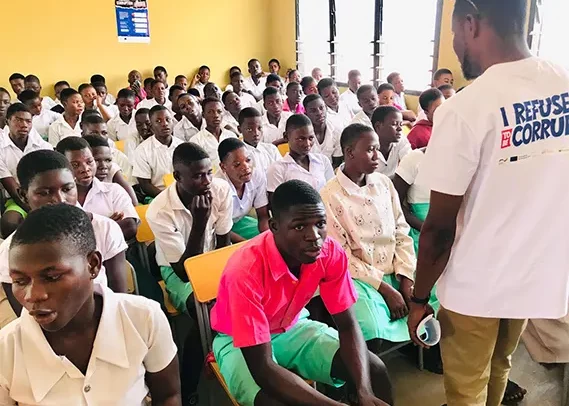
A scene during the programme
The fight against corruption received a major boost in the Bunkpurugu‑Nakpanduri and Yunyoo‑Nasuan districts of the North East Region on December 9-10, 2025, when the Ghana Anti‑Corruption Coalition (GACC) led school engagement events to mark International Anti‑Corruption Day.
As part of nationwide activities to commemorate the day, GACC brought together hundreds of young people to deepen their understanding of corruption, its dangers, and their role in building a more accountable society.
With support from the William and Flora Hewlett Foundation and the GIZ and European Union (EU)‑funded PAIReD programme, GACC engaged students at Yunyoo Senior High School (SHS) and Jimbale Junior High School (JHS) in the Yunyoo‑Nasuan District, and at Konchian‑Gberuk JHS and Nakpanduri SHS in the Bunkpurugu‑Nakpanduri District.
A speech read by a representative of Aid for Peace Rural Education and Development, Mohammed Haki, on behalf of GACC Executive Secretary Mrs. Beauty Emefa Narteh, noted that corruption remains one of Ghana’s greatest threats to development, economic progress and democratic stability.
“Corruption drains public resources and weakens institutions. Every cedi lost is a missed opportunity for better schools, improved healthcare, stronger infrastructure and decent jobs. The burden of corruption falls heavily on young people, whose aspirations are undermined by weakened systems and distorted opportunities,” he said.
Mr. Haki indicated that this year’s global theme, “Uniting with Youth Against Corruption: Shaping Tomorrow’s Integrity,” aligns closely with GACC’s nationwide work in schools and communities, noting that its Local Accountability Networks (LANets) reached more than 50,000 young people across 34 districts with anti‑corruption education and election‑integrity campaigns.
He said empowering the youth is a strategic investment in Ghana’s future, and urged parents, teachers, faith and community leaders, as well as state institutions to support young people in upholding integrity and promoting justice.
During open‑forum sessions, many students shared personal encounters that illustrated how corruption affects their daily lives.
A student at Nakpanduri SHS described favouritism at health facilities, saying, “When you go to the hospital, the person who knows someone gets treated first, even if they came late. I have seen it many times, and it is painful.”
Other students recounted police checkpoints where officers allegedly take bribes from riders and drivers, shaping their views of fairness and public service.
“We see it every day. Some people feel that bribery is normal because adults do it openly. We need leaders to set better examples for us,” one pupil said.
Students also highlighted broader community consequences, such as abandoned borehole projects, uneven distribution of development resources and misuse of public property.
“We have communities where projects start and are never completed. When you ask why, adults say the money has been ‘eaten’. It makes us feel that nothing will change unless we speak up,” a Jimbale JHS student said.
Teachers noted that corruption contributes to infrastructural deficits, inadequate furniture, poor sanitation and incomplete school projects, which harm teaching and learning.
Students and teachers therefore proposed practical measures to prevent corruption in schools and communities, including strengthening school integrity clubs, holding community dialogues, encouraging whistleblowing, and integrating ethics and integrity into the curriculum.
At the close of the programme, students made a collective pledge to stand against corruption, act honestly in their daily lives and inspire their peers to do the same.
Teachers commended the students’ enthusiasm, saying that shaping future leaders begins with nurturing integrity today.
FROM Eric Kombat