
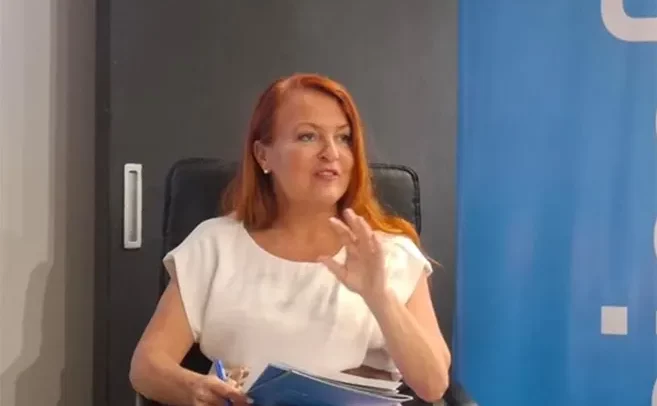
Pauliina Sarvilahti
Ghana spends too little, too late, and too unevenly on its children, with the youngest and poorest missing out on critical early investments, a new UNICEF study warns.
The report, “Unlocking Potential Early: Rebalancing Public Spending for Children in Ghana”, is the first age-based analysis of public expenditure on children from pregnancy to age 17.
UNICEF Ghana Chief of Social Policy, Pauliina Sarvilahti, giving details of the study at a media engagement in Accra said while Ghana outperforms much of Sub-Saharan Africa on key child indicators, the study finds public investment is backloaded toward later childhood and skewed toward wealthier households, undercutting gains from the recently launched Early Childhood Care and Development Policy.
She noted that Ghana’s immunization coverage stands at 95%, far above the regional average of 74%.
“Under-five mortality is 35.9 per 1,000 live births, roughly half the Sub-Saharan average of 71.2. Pre-primary enrolment is among the highest in the region at 88.1%. Yet spending patterns do not match early-childhood needs. Children aged 0–5 make up about one-third of Ghana’s child population but receive only 13% of total public spending on children,” she explained.
She further highlighted the stark wealth gaps where children from the richest households receive nearly twice as much public investment per capita as those from the poorest households.
“Rural-urban disparities persist, especially in education and access to services,” she added.
Lead Researcher and Managing Director of the Learning for Well-being Institute, Dominic Richardson, also noted that the research showed public spending on children is heavily concentrated in education, which took about 3.1% of GDP in 2023.
“Other critical sectors remain underfunded: health accounted for roughly 2.0% of GDP, social protection at 0.23%, and child protection just 0.03%,” he said.
He noted that across Sub-Saharan Africa, about nine of every ten public dollars invested in children go to education — a pattern Ghana mirrors.
“By contrast, high-income countries spend almost 23 times more than Ghana and the average, with resources spread more evenly across childhood and a balanced policy mix,” he added.
Mr. Richardson said despite gains in immunisation, mortality, and pre-primary enrolment, Ghana still faces challenges in nutrition, birth registration, child poverty, and protection from violence.
“Public spending choices can either reinforce disadvantages or help break its cycle, particularly for children from poorer households,” he said.
Recommendations
The report calls for three shifts: spend more, spend earlier, and spend more fairly across childhood.
It urges a balanced child policy portfolio that strengthens income support for families — including expanded Livelihood Empowerment Against Poverty (LEAP) benefits for pregnant mothers — alongside parental leave, childcare, child grants, nutrition, health, parenting services, and child protection, while safeguarding education gains.
UNICEF recommended using the Early Childhood Care and Development Policy (2025–2035) as the framework for gradual, strategic reform and scale-up.
“Modelling by UNICEF shows a comprehensive package of investments, estimated at 7.2% of GDP, could deliver rapid results. Child poverty would be eliminated within three years. Up to 18,000 premature child deaths would be averted. Stunting would fall significantly and vaccination coverage would hit 100%. Birth registration would reach near-universal levels.
“School readiness and enrolment would improve as more children enter school prepared to learn. The study concludes that fast-tracking and prioritising implementation of the new ECCD Policy could be a “game changer” for Ghana and Africa. UNICEF said the findings show not just how much Ghana spends on children, but which children benefit most — and least — from that spending,” the report said.
A Daily Guide Report