
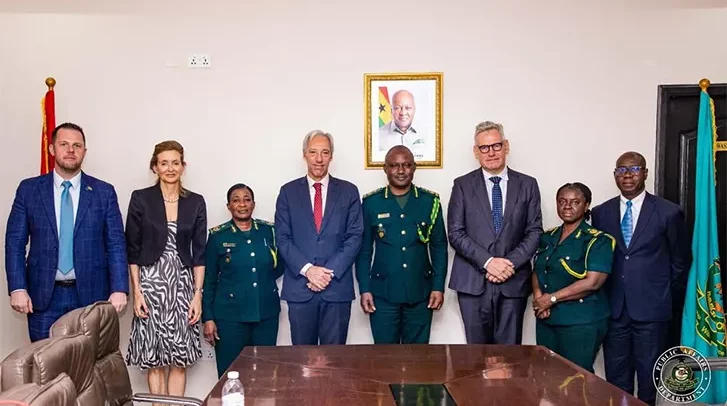
The Comptroller-General (fifth from right), his guests and some of his management staffers after the engagement
The Ghana Immigration Service (GIS) has hosted a high-level delegation from the European Union (EU), led by the EU Special Representative for the Sahel, João Cravinho, to deepen cooperation on border security, migration management, and resilience across the Sahel and Coastal West Africa.
The engagement reaffirmed the longstanding, strategic partnership between Ghana and the EU, particularly in strengthening security preparedness in the northern frontier.
Mr. Cravinho explained that his mandate involves working closely with all 27 EU Member States, which requires an in-depth understanding of the realities on the ground in countries like Ghana.
He commended Ghana’s internal security initiatives and vigilance, saying the country “has been resilient to the risk of incursions from terrorists because of local initiatives,” observing that “Ghana is safe but very vigilant.”
Reflecting on his meetings with the GIS Northern Regional Command, the Armed Forces and civil society organisations, Mr. Cravinho said he was impressed by the good coordination between institutions in the Northern Region.
Comptroller-General of Immigration, Mr. Samuel Basintale Amadu, expressed appreciation for the EU’s longstanding support. He emphasised that the Service does not take for granted the continuous technical and logistical assistance provided through the International Centre for Migration Policy Development, International Organisation for Migration, and various EU-backed initiatives.
He highlighted persistent operational constraints, including mobility challenges: “Despite the vast border area, mobility is a challenge for the Service, especially in the northern frontiers, impeding patrols and effective border and migration management.”
He further explained how deep community ties complicate identification processes along the border, noting that “sometimes boundaries cut through houses, showing how interconnected these borders are – one chief, the same ethnic groups – and criminals take advantage, disguising themselves as border residents.”
Deputy Comptroller-General for Operations and Command Post, Mr. Laud Affrifah, elaborated on the ethnic and geographic complexities that challenge northern border management. He noted that “ethnic dynamics is a challenge,” and that Ghana has adopted a series of strategies – most prominently the multi-agency Operation Conquered Fist – to place boots on the ground across the over 500km stretch of northern boundaries.
He emphasised the need for enhanced surveillance technology and expressed appreciation for progress under the EU-funded European Union Security and Defence Initiative (EUSDI) project, explaining that while the system is expected to become fully operational next year, “there is the need to expand the use of technology in the vast stretch.”
Drawing on lessons from attacks on border posts in neighbouring regions, he stressed the need for rapid response units and more training for officers. He highlighted growing collaboration with training institutions, the EU’s visit to the Immigration Tactical Training School, and ongoing work to upgrade officer training capacity.
EU Ambassador to Ghana, Rune Skinnebach, commended the GIS for its professionalism and stability-enhancing initiatives. He said it was “interesting to hear about endeavours to maintain stability,” and expressed his satisfaction with the performance of the EUSDI programme.