
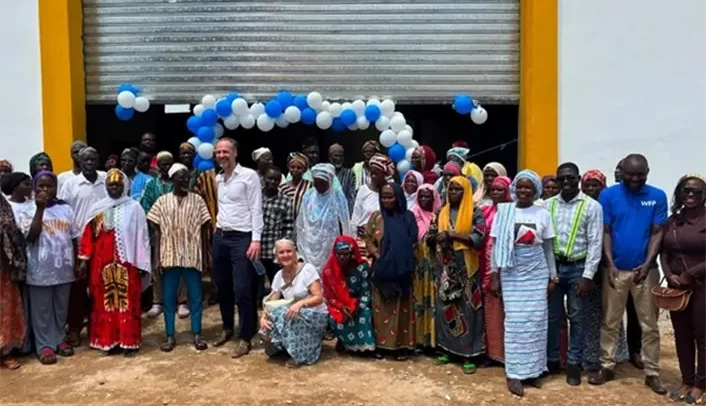
A group photo of participants
The German Development Cooperation, in partnership with Saving Grains 301 GmbH, has handed over a newly constructed community warehouse to farming communities in Shebo in the Northern Region in efforts to reduce post-harvest losses and improve market access for smallholder farmers.
The warehouse, inaugurated during the closing week of the Fund for the Promotion of Innovation in Agriculture (i4Ag) project, will provide safe grain storage, facilitate aggregation and quality management, and serve as a marketplace where farmers, traders and buyers can connect and conduct business.
Funded by the German Federal Ministry for Economic Cooperation and Development (BMZ) and implemented by the Deutsche Gesellschaft für Internationale Zusammenarbeit (GIZ) GmbH in collaboration with Saving Grains 301 GmbH and local farming communities, the i4Ag project sought to address one of the most persistent challenges facing Ghana’s grain sector, post-harvest losses, which can account for up to 40 percent of harvested grain.
Over the past two years, the project introduced an integrated package of innovations aimed at improving post-harvest management. These included hermetic storage bags, digital quality monitoring and traceability systems, improved storage infrastructure, biomass-based grain drying technologies and market-driven business models designed to create new economic opportunities for rural entrepreneurs while enhancing market access for smallholder farmers.
Project results showed significant improvements in the adoption of modern post-harvest technologies and farming practices.
More than 16,000 smallholder farmers, including over 8,000 women, received training in improved post-harvest management. About 90 per cent of those trained adopted at least one of the promoted innovations, while 80 per cent reported a reduction in post-harvest losses.
The project also facilitated the formation of 27 farmer groups, many of them led by women and young people, to strengthen collective marketing, improve knowledge sharing and increase access to financial services.
Working with Saving Grains 301 GmbH, the project also demonstrated the commercial viability of market-based post-harvest solutions.
More than 18,000 farmers registered on the Saving Grains digital platform, over 1,000 metric tonnes of grain were traded during the past 12 months, more than 6,000 hermetic storage bags were introduced onto the Ghanaian market, and post-harvest losses within the company’s business model were reduced by 17.5 percent.
Speaking on behalf of the Sector Coordinator for Sustainable Economic Development at GIZ Ghana, Issah Nadjo, attributed the project’s success to strong collaboration among public and private sector partners.
According to him, partnerships with the Ministry of Food and Agriculture (MoFA), Farm North Ghana, the Kwame Nkrumah University of Science and Technology (KNUST), SESI Technologies and other national stakeholders enabled innovative technologies to be tested under Ghanaian conditions while strengthening local ownership and laying the foundation for their continued use after the project’s completion.
“As the project comes to an end, its legacy extends beyond the innovations introduced,” he said, adding that the partnerships forged had strengthened institutional capacity and promoted sustainable agricultural development.
The Greater Accra Regional Director of the Department of Agriculture, Rogatta Antwi-Baadu, said the project’s impact would continue to benefit farming communities long after its completion.
She noted that infrastructure such as the Shebo community warehouse, together with strengthened partnerships and enhanced technical capacity, would contribute significantly to reducing post-harvest losses, improving food security and creating new economic opportunities for smallholder farmers and rural entrepreneurs across the country.
A Business Desk Report