

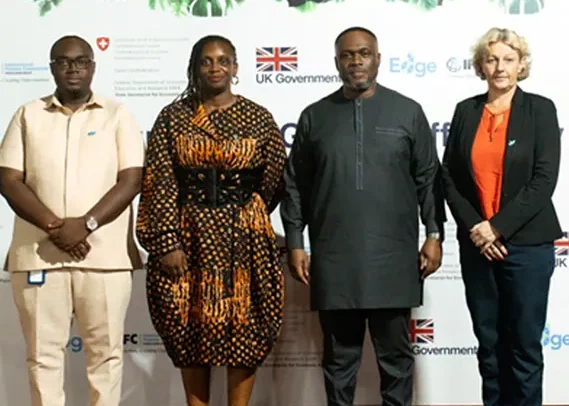
Kenneth Adjei (2nd R) with officials at the event
The Minister for Works, Housing and Water Resources, Kenneth Adjei, has stated that green buildings are no longer a luxury in the built environment but a necessity, critical to addressing the challenges confronting the country amid rapid urban expansion.
Speaking at the International Finance Corporation (IFC) EDGE Close-Out event at the World Bank office in Accra, the Minister said adherence to regulations governing the built environment is essential not only for securing a liveable human habitat but also for ensuring measurable efficiency in the use of energy, water and other resources.
He explained that the IFC in 2022 launched the Designing for Greater Efficiency (DfGE) programme to provide training aimed at strengthening the capacity of technical experts, including architects, engineers and construction professionals.
“Green buildings are no longer a luxury; they are a necessity. In the face of climate change, resource scarcity and urban expansion, they are essential to securing a liveable and equitable future for generations to come. Let us not forget that buildings are far more than concrete and steel,” he stated.
Mr. Adjei reaffirmed the government’s commitment to embedding sustainability, climate resilience and resource efficiency in the built environment, while commending the Swiss Embassy for its support.
He noted that rapid urbanisation is intensifying pressures in Ghana, making it imperative for the country to tackle the situation head-on and redefine what building truly entails.
“Our focus is no longer solely on the numbers and how we construct, but why we build, with what and for whom. Our goal is clear: to create structures that minimise environmental harm, maximise resource efficiency, and enhance human well-being and prosperity,” he said.
That commitment, he explained, is reflected in the country’s Nationally Determined Contributions under the Paris Agreement.
The Minister further expressed gratitude to architects, engineers, planners and developers who are already integrating energy-efficient systems, renewable energy and sustainable local materials into their projects.
He said such choices not only reduce energy use and emissions but also create healthier and more comfortable spaces for people to live and work.
The three-year programme, implemented with support from the Swiss State Secretariat for Economic Affairs (SECO), equipped architects, engineers and other building professionals with skills to design resource-efficient structures.
IFC Senior Country Officer for Ghana, Yewande Giwa, said the training addressed a critical need in the fight against climate change, noting that buildings account for about 40 percent of energy-related greenhouse gas emissions.
Deputy Head of Cooperation at the Swiss Embassy in Ghana, Magdalena Wüst, said the Embassy was proud to support a programme that empowered institutions and students with practical skills in the built environment.
The training curriculum covered modules on foundational green building concepts, energy-efficiency analysis, water conservation and other related areas.
The close-out event, held under the theme “Building Capacities for Building Decarbonisation: Expanding Implementation Strategy,” trained a total of 254 professionals and students.
By Ebenezer K. Amponsah