
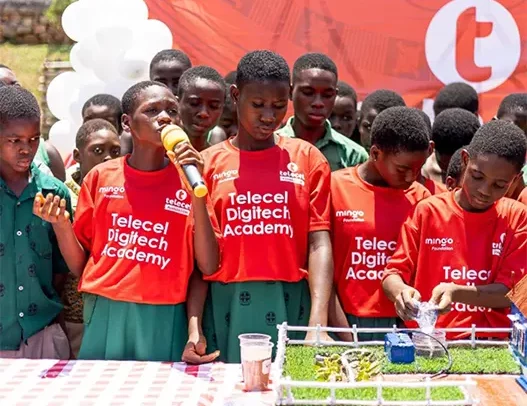
Ruth Martey and teammates showcase smart farm
Persistent low rainfall and rising temperatures in Peki and its neighbouring communities are taking a toll on agriculture, leaving farmlands parched and increasingly difficult to cultivate, particularly during the dry season.
But a group of Junior High School (JHS) students is offering a glimpse of how technology could help farmers adapt.
At the Peki Blengo Evangelical Presbyterian Junior High School, students participating in the Telecel DigiTech Academy have developed a prototype “smart farm” designed to address water scarcity challenges.
The innovation, built after a 12-week hands-on training in robotics and coding, was unveiled during the academy’s third cohort graduation ceremony in the South Dayi District of the Volta Region.
The project leader, Ruth Martey, explained that the idea was inspired by the daily struggles of farmers in their community.
Farming, she noted, remains the primary livelihood for many families in the area, yet access to water continues to be a major constraint.
The team’s smart farm integrates an automated irrigation system capable of sourcing water from underground reserves or nearby water bodies such as rivers and lakes.
Using soil moisture sensors, the system activates irrigation whenever conditions fall below optimal levels, ensuring crops receive adequate water without manual intervention.
It also features a night lighting mechanism aimed at deterring animals that often destroy crops under the cover of darkness.
One local farmer, Evans Owusu, who has spent 25 years cultivating cassava, plantain and cocoa, said the students’ innovation reflects the realities of erratic rainfall patterns.
He observed that delayed rains often disrupt planting cycles and reduce yields, adding that a fully developed version of the prototype could significantly boost productivity and incomes for farmers.
The smart farm was among several capstone projects presented by nearly 500 students drawn from 19 schools across five regions.
Other innovations included fire and theft alarm systems, e-commerce platforms, rain detectors and various agricultural tools.
The Head teacher of the school, Vincent Adzagbenu, commended the programme for enhancing critical thinking and problem-solving skills among students, describing it as a practical approach to education that prepares learners for future challenges.
The Telecel DigiTech Academy, implemented with support from Mingo Foundation and Asustem Robotics in partnership with the Ghana Education Service and the National STEM Centre, equips students with skills in Scratch programming, Arduino robotics and web design, which they apply to solving real-life problems.
Although many of the projects remain at prototype stage and require further development and funding, Telecel Ghana said the initiative is aimed at nurturing innovation and empowering young people to become problem-solvers in their communities.
Since its launch in 2024, the programme has trained over 2,300 students across 13 regions, with plans to expand its reach nationwide in subsequent cohorts.
A Business Desk Report