
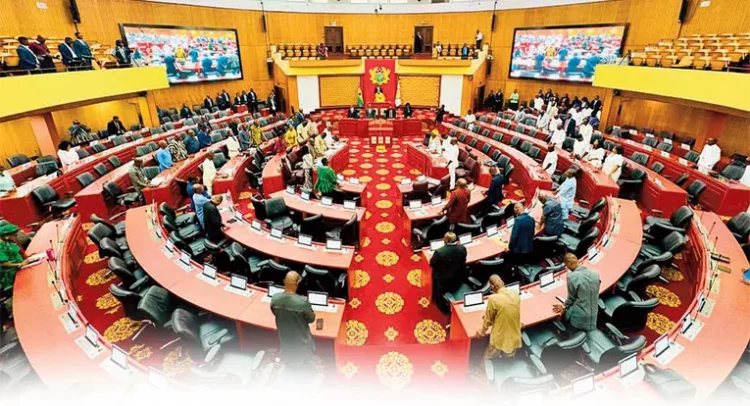
Parliament has passed the controversial Human Sexual Rights and Family Values Bill, popularly known as the anti-LGBTQ bill, following months of heated national debate, political disagreement and international scrutiny.
The legislation, sponsored by bipartisan lawmakers in the previous Parliament, seeks to criminalise LGBTQ+ activities, advocacy, promotion and sponsorship, while reinforcing what it describes as traditional family values.
However, the passage of the bill was immediately met with sharp criticism from members of the Minority Caucus, who accused the governing National Democratic Congress (NDC) of diluting key provisions of the original bill through last-minute amendments.
Minority Leader Alexander Afenyo-Markin described the revised legislation as “watered down”, accusing the NDC of abandoning the strict principles it once championed while in opposition.
“Today we know that the very law that they wanted Nana Akufo-Addo to sign, they have amended and diluted,” he said on the floor of Parliament.
He added, “What you have passed today is empty. It does not address the very concerns you claim you believe in.”
Mr. Afenyo-Markin also alleged procedural irregularities during the consideration of the bill, claiming that some of the original sponsors were absent during critical stages of the debate and voting process.
He further accused the NDC of political inconsistency, arguing that the party had previously mounted pressure on former President Akufo-Addo to assent to the earlier version of the bill but had now altered its content after assuming office.
“We may be few, but we are armed with principle,” the Minority Leader declared, warning that “posterity will judge” the actions of the government.
MP for Assin South, John Ntim Fordjour, one of the original sponsors of the bill introduced as a Private Member’s Bill, also criticised the amendments, describing them as dangerous exemptions that undermine the intent of the legislation.
According to him, the original bill was specifically designed to clamp down on the promotion, sponsorship and advocacy of LGBTQ+ activities, which he said was the “very meat” of the legislation.
Mr. Fordjour said the revised version exempts certain categories of persons and organisations, including journalists, academics, health professionals, NGOs and development partners, from sanctions relating to advocacy and dissemination of information.
“These exceptions were never part of the discussions,” he said at a press briefing, and added, “They have smuggled them in to exempt the very groups we sought to regulate.”
He argued that the changes would allow organisations and individuals accused of promoting LGBTQ+ activities to continue operating under the cover of academic research, healthcare delivery, journalism and public health functions.
The Assin South MP further alleged that foreign interests had influenced the amendments to the bill, insisting that the revised legislation no longer reflected the aspirations of the majority of Ghanaians.
“This is a sad day. If you exempt the real targets of the law, then we do not have any law at all,” he said.
Despite the opposition criticism, the Majority side maintained that the legislation balances the nation’s cultural and religious values with constitutional protections and professional obligations in sectors such as healthcare and journalism.
The bill is now expected to be transmitted to President John Mahama for assent.
By Ernest Kofi Adu, Parliament House