
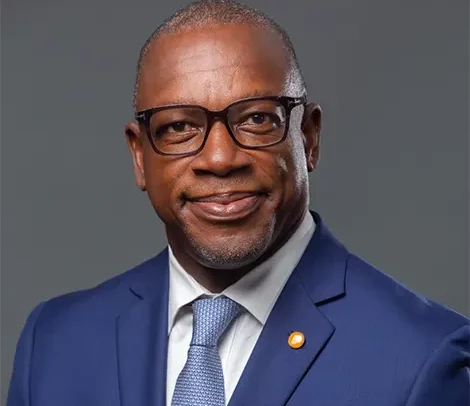
Edward Effah
Founder of Fidelity Bank Ghana, Edward Effah, has called for a bold and structured partnership between government and the private sector to drive the nation’s next phase of economic transformation, arguing that macroeconomic stability alone will not deliver the jobs, industrial growth and prosperity the country needs.
Addressing the 10th Ghana CEO Summit in Accra, Mr. Effah said Ghana was at a critical moment in its development and must seize emerging opportunities to accelerate economic growth.
The summit, held under the theme, “The CEO-Government Compact 2026: Accelerating Ghana’s Economic Transformation,” was attended by President John Dramani Mahama, ministers of state, the Governor of the Bank of Ghana and business leaders.
According to Mr. Effah, Ghana has made significant economic progress in recent years, with Gross Domestic Product (GDP) rising from $56 billion in 2016 to an estimated $115 billion in 2026, making it the eighth-largest economy in Africa.
He also cited low inflation and strong international reserves as evidence of improved macroeconomic stability.
Despite these gains, he noted that unemployment, particularly among the youth, remains a major challenge.
“Today there are 1.5 million young Ghanaians who are not in employment, education or training. To transform our economy and create jobs, the private sector and government urgently need to work together,” he said.
To address the challenge, Mr. Effah proposed the establishment of a CEO-Government Compact anchored on two key institutions. The first is a National Economic Transformation Council, chaired by the President, to set targets, remove bottlenecks and monitor implementation of key reforms. The second is a Transformation Delivery Unit tasked with coordinating programmes in agribusiness, manufacturing, technology, energy, infrastructure and financial services.
He suggested that the Delivery Unit be established through legislation to ensure continuity beyond political administrations, drawing inspiration from development models in Singapore and Rwanda.
Mr. Effah further called for the mobilisation of about $25 billion in investments over the next five years to support priority sectors of the economy.
He said the funding should come from a mix of commercial banks, development finance institutions, international partners and direct private investment.
According to him, such investment is necessary if Ghana is to create jobs for the growing labour force, sustain high economic growth and expand its export base.
He expressed confidence that the private sector would respond positively to a clear and credible transformation agenda, citing successful collaborations such as the COVID-19 Private Sector Fund, which financed the construction of the Ghana Infectious Disease Centre, and efforts that helped address indebtedness in the energy sector.