
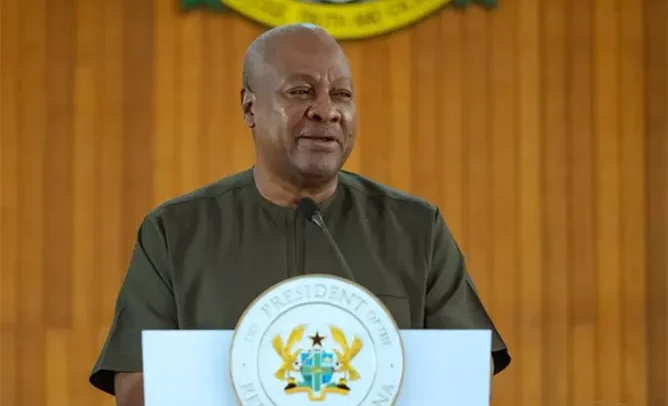
President John Dramani Mahama has announced sweeping education financing reforms aimed at expanding access to tertiary education while easing the financial burden on students and their families.
Presenting his State of the Nation Address to Parliament, the President said the reforms form part of a broader Resetting Ghana Agenda focused on inclusion, human capital development and long-term economic transformation.
At the heart of the reforms is the implementation of the No-Fees-Stress Initiative, a policy designed to eliminate upfront academic user fees for first-year students in public tertiary institutions.
According to the President, more than 150,000 students have already benefited from the intervention, with projections indicating that over 220,000 fresh entrants will be covered in the next academic year.
“This policy is about opportunity,” he told lawmakers, stressing that financial barriers should not determine a young person’s access to higher education.
He said his government also plans to expand the reach of the Students Loan Trust Fund to ensure that needy but qualified students can access timely and adequate financial support.
He stated that the reforms are expected to simplify loan application processes, improve disbursement timelines and strengthen recovery systems to sustain the scheme.
Additionally, free tertiary education will be extended to persons with disabilities, reinforcing what the President described as the administration’s commitment to inclusive education.
According to him, beyond tuition relief, the reforms are aligned with broader structural changes in the education sector.
President Mahama disclosed that three new Technical Universities are to be established to expand access to practice-oriented and industry-driven programmes.
Government will also construct six Regional Technical and Vocational Education and Training (TVET) Centres of Excellence to enhance skills training and reduce the mismatch between education output and labour market needs.
The President noted that the financing reforms are being introduced alongside curriculum modernisation efforts, including the integration of artificial intelligence, robotics and coding into basic education.
These measures, he said, will ensure that increased access is matched with relevant and future-ready skills.
The President assured Parliament that the measures have been carefully integrated into the 2026 Budget framework and are supported by improved fiscal discipline and enhanced domestic revenue mobilisation.
“Education remains the single most powerful tool for national transformation,” he said, arguing that investment in young people yields long-term dividends for productivity and social mobility.
By Ernest Kofi Adu, Parliament House