

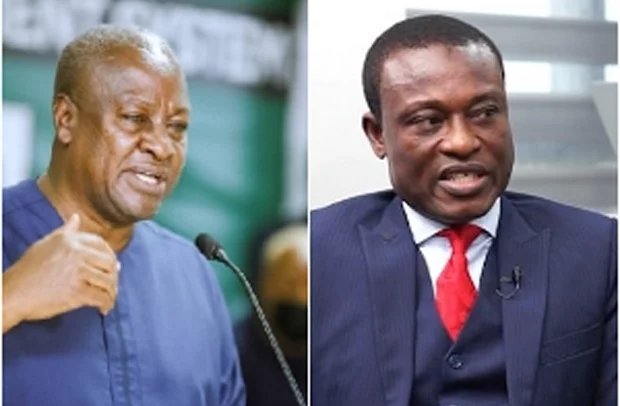
President John Mahama, Kissi Agyebeng
President John Dramani Mahama has ordered the leadership of the Majority Caucus in Parliament to immediately suspend their push to repeal the law establishing the Office of the Special Prosecutor (OSP), halting a legislative move that had stirred nationwide debate over the future of the country’s foremost anti-corruption institution.
The directive, issued in a statement signed by Minister for Government Communications and Presidential Spokesperson, Felix Kwakye Ofosu, and released yesterday, instructed the Majority Leader, Mahama Ayariga, and the Majority Chief Whip, Rockson-Nelson Dafeamekpor, to withdraw the Private Members’ Bill seeking to dismantle the OSP.
This intervention came just days after the two Members of Parliament (MPs) completed the drafting of the Office of the Special Prosecutor (Repeal) Bill, 2025, which was dated December 8, 2025 and had been prepared for submission to Parliament.
According to the Presidency, the order aligns with President Mahama’s reaffirmation of his commitment to strengthening the OSP during an engagement with the National Peace Council on Wednesday.
At that meeting, the President reportedly openly declared that the anti-graft office remains a crucial pillar in the nation’s fight against corruption and must be supported rather than abolished.
The statement emphasised that while legitimate concerns exist about the operational effectiveness of the OSP, it is “premature to shut down the office,” and that the proper corrective measure should be a reform, not dissolution.
The President reiterated his earlier call on the OSP to intensify its efforts, improve its systems, and enhance public confidence in its work in order to fully justify its establishment.
The Draft Bill
The halted bill, however, had built a comprehensive legal argument for the collapse of the OSP. The accompanying memorandum, jointly signed by Messrs Ayariga and Dafeamekpor, asserted that operational experience over the past eight years had exposed unresolved structural and constitutional contradictions between the functions of the OSP and those of the Attorney-General.
It argued that maintaining two independent prosecutorial bodies had contributed to institutional friction, jurisdictional overlap and delays, and had undermined the coherence of Ghana’s national prosecutorial strategy.
The memorandum further contended that the OSP’s budget had not translated into commensurate impact and that its parallel administrative structure had placed undue strain on public finances.
It suggested that the constitutional requirement under Article 88, which vests exclusive prosecutorial authority in the Attorney-General, made the OSP redundant in principle and inefficient in practice.
The repeal bill itself contained sweeping provisions that would have dissolved the OSP entirely and transferred every aspect of its operations to the Office of the Attorney-General and Ministry of Justice.
All assets, liabilities, bank accounts, files, databases, contracts and confidential information held by the OSP were to be transferred to the Attorney-General.
The draft bill also said OSP’s entire workforce was to be reassigned to the Ministry of Justice under conditions no less favourable than those they currently enjoy, while employees unwilling to make the transition would have been permitted to request redeployment or exit the public service.
All ongoing investigations and prosecutions initiated by the OSP would have continued seamlessly under the authority of the Attorney-General, who would also have been empowered to issue directives to manage any matter not expressly covered under the repeal legislation.
The bill further stipulated that every reference to the OSP in any existing law would, upon its passage, be legally interpreted as a reference to the Attorney-General.
By Ernest Kofi Adu, Parliament House