

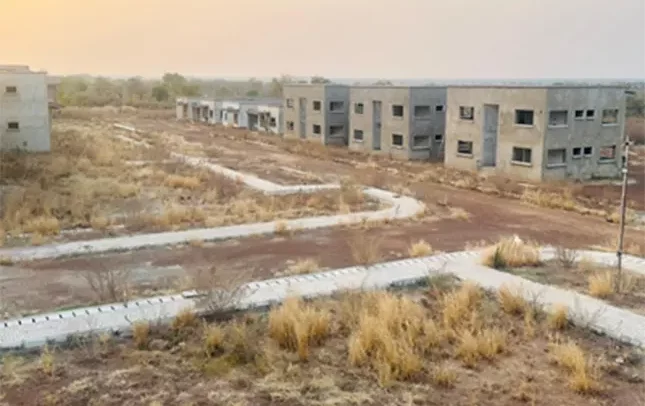
The abandoned Tamale Psychiatric Hospital
The people of the five northern regions welcomed the construction of a Psychiatric Hospital in Tamale, as a potential game changer in tackling drug abuse and mental health problems. However, the now-abandoned structure is being described as a setback to government efforts to address mental health and its related issues.
Residents say the absence of a functioning psychiatric facility undermines the work of the IGP’s Special Operations Team in curbing drug-related activities across the regions. Many have questioned how people arrested for drug offenses are assessed and treated, and whether they receive the needed psychiatric attention or rehabilitation to prevent further drug use and criminality.
In 2023, the Government began construction of the Tamale Psychiatric Hospital at Tugu Yapala, a suburb of Tamale in the Northern region under the Agenda 111 initiative to improve access to psychiatric services.
The project includes male and female wards, an occupational therapy facility, a medical waste disposal facility, security posts, a family hostel for patients’ relatives, executive apartments, and various non-medical support services.
A visit by DAILY GUIDE, to the Tamale Psychiatric Hospital, found that contractors had left, locking up some working machines and equipment. Although the buildings are nearly complete, weeds have taken over the compound and the heavy machinery and vehicles have been removed from the site, a security guard said.
IGP Special Operations Team
To curb drug-related activity and maintain law and order in the Tamale Metropolis, the Inspector General of Police’s (IGP) Special Operations Team of the Ghana Police Service has been conducting routine patrols and intelligence-led operations in identified crime-prone areas. Commanded by DSP Bawa Abdul Jalil, the team carries out swoops across the Northern Region based on actionable intelligence about suspected drug activity.
The team’s operations have contributed significantly to maintaining public safety in the Tamale Metropolis, boosting public confidence and deterring criminal activity—particularly drug-related offenses. Thousands of people across the five northern regions have been arrested and remanded in connection with drug-related offenses.
The IGP’s team has also seized boxes of opioids and tramadol, as well as wrappers of substances suspected to be Indian hemp and other illicit drugs. Community members and local leaders continue to call for the completion and commissioning of the psychiatric hospital so that those in need of mental health care and rehabilitation can receive appropriate support.
Clinical Health Psychologist Perspective
Clinical health psychologist and lecturer at the School of Medicine, University for Development Studies (UDS), Peter Mintir Amadu, told DAILY GUIDE that the absence of a psychiatric hospital in Northern Ghana severely undermines healthcare delivery.
He said mental health conditions such as psychosis, substance-use disorders, severe depression, and trauma-related illnesses require specialized, structured rehabilitation that general hospitals are often not equipped to provide.
Without a dedicated facility, patients can be mismanaged, stigmatised, or discharged prematurely due to space constraints, worsening outcomes and increasing relapse rates placing a heavy burden on families and community health systems.
“Psychiatric facilities are central to the comprehensive rehabilitation process, offering clinical diagnosis, detoxification, psychotherapy, psychosocial support, and reintegration services delivered by trained professionals.
While Ghana’s Mental Health Act (Act 846, 2012) promotes community-based care, this approach still depends on referral and support from well-resourced psychiatric facilities. These facilities, I often say, are largely coastal and colonial in origin. Strengthening both general and specialist facilities—like a psychiatric hospital in the North—is therefore essential to ensuring equitable, quality mental healthcare for the northern population,” he said.
Mr. Amadu noted that mental health is arguably the greatest health need yet remains one of the most neglected. He said the abandoned psychiatric hospital in Tamale symbolises the low prioritisation of mental health in the region, a neglect that is costly for the north.
“As practitioners, we often say there is truly no health without mental health. The absence of a functional psychiatric facility in Northern Ghana forces complex psychiatric cases into general hospitals with limited capacity and specialist expertise.
“The Mental Health Act (2012) mandates integration of mental healthcare into primary and community health systems. While progress has been made, implementation continues to struggle, especially in the northern regions where infrastructure is weakest,” he noted.
According to him, completing the Tamale Psychiatric Hospital is not merely a construction project but a national investment in health equity, social stability, and human dignity adding that a fully operational facility would provide specialised rehabilitation for individuals battling substance-use disorders, severe mental illness, and trauma-related conditions. It would also support training, research, and community outreach to improve mental health literacy and reduce stigma.
He called on the government, development partners, and relevant stakeholders to prioritise and fast-track the hospital’s completion.
“Doing so aligns with the universal health coverage agenda and strengthens our commitment to the Sustainable Development Goals (SDGs). The people of Northern Ghana deserve accessible, quality psychiatric care, and this facility is a crucial step toward that goal,” he stated.
Responding to the IGP’s special team tackling illicit drugs in the Northern Region, Mr. Amadu commended the team for disrupting drug supply networks but warned that the fight against drug abuse is multi-layered and requires more than enforcement.
“The taskforce addresses the first layer: law enforcement and supply reduction. But without strong health infrastructure—especially a psychiatric hospital—the demand side remains unresolved. Drug abuse and dependence are fundamentally mental health and public health issues. Many users suffer underlying psychological distress, addiction disorders, or co-occurring psychiatric conditions.
“Arresting or deterring them without offering structured rehabilitation often leads to cycles of relapse, crime, and social instability. An operational psychiatric facility would provide diagnosis, detoxification, therapy, relapse prevention, and long-term recovery support—services that would make enforcement actions translate into healing, not just punishment,” he stressed.
He said the team’s effectiveness would be significantly amplified if linked with an operational psychiatric hospital, enabling coordinated action across security, healthcare, community, and family systems.
The clinical health psychologist and lecturer argued that tackling drug abuse and mental health in Northern Ghana requires a comprehensive, multi-sectoral strategy: strong advocacy and public education, access to psychiatric and rehabilitation services, structured therapy, livelihood empowerment, and skills training—since economic vulnerability often fuels substance abuse.
He urged the youth of Northern Ghana to focus on education, learn positive coping mechanisms for stress and peer pressure, and develop practical life and vocational skills as alternatives to substance use.
“Surround yourself with peers who support your growth and well-being. When you feel overwhelmed, seek help from trusted adults, counsellors, or mental health professionals. Drug abuse destroys not only individual lives but entire families and communities. You are today’s leaders innovating for tomorrow’s success, choose a path that protects your health, your dreams, and your potential. Stay disciplined, informed, and connected to positive influences, and you can build a strong, fulfilling future free from substance abuse,” he advised.
CSOs Perspective
Founder of The New Africans Development (NAD), a non-governmental organization (NGO), Joseph Youpaab Tiibe, also joined the call, appealing to state authorities to urgently ensure the completion of the Tamale Psychiatric Hospital to complement the IGP Special Operations Team’s efforts to fight drug abuse and address mental health in the five regions of the North.
“The completion of the Tamale Psychiatric Hospital by the government is essential because it will support other stakeholders working to tackle drug abuse and mental health issues in the region. The IGP Special Operations Team is doing well, but after arrests what happens next? We need a facility to help rehabilitate those with substance abuse and related mental health problems,” he said.
Data
Substance abuse among adolescents and youth in Northern Ghana has risen into a major public health and socioeconomic crisis: recent 2024–2025 studies report lifetime substance use by 58.4% to 62.3% of surveyed young people, with high use of shisha 48% tramadol 24% alcohol 12% and marijuana 8.2%.
About 58.4% of youth ages 12–20 and 62.3% of high school students reported lifetime substance use such as Shisha, Tramadol, Alcohol, Marijuana; also Cigarettes and glue with peer pressure 53.4%, inadequate parental supervision 48.2%, curiosity 38.9%, boredom 3.4%, and easy access through friends, dealers and porous borders being the cause.
Nearly half, 48.4%, report mental health problems including psychosis rising school dropout, absenteeism and poor performance; increased robbery, bullying and vandalism.
Although 8.4% know about support services, only 41.6% would seek help due to stigma and fear of punishment and therefore integrate drug education into schools, expand community-based rehabilitation, strengthen parental engagement, and run stigma-reduction campaigns is greatly needed.
SDG
SDG Target 3.5 focuses on strengthening the prevention and treatment of substance abuse, including narcotic drug abuse and the harmful use of alcohol, to ensure healthy lives and promote well-being for all at all ages but the lack of a Psychiatric hospital within the five regions of the north could affect the achievement of this goal.
The abandoned Tamale Psychiatric Hospital
The IGP Special Operations Team led by DSP Bawa Abdul Jalil
Mr. Peter Mintir Amadu,
Mr. Joseph Youpaab Tiibe,
FROM Eric Kombat, Tamale