
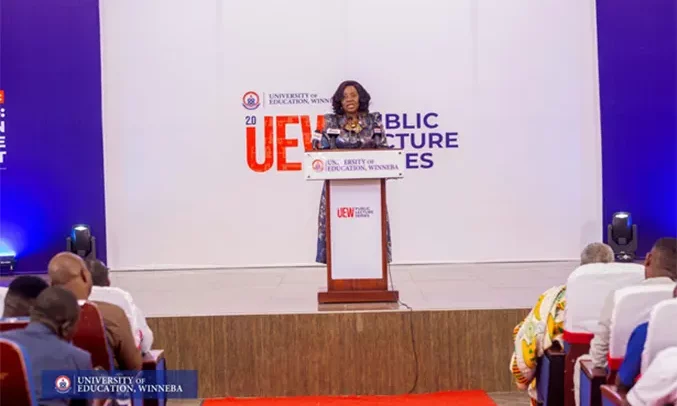
Ing. Patricia Obo-Nai speaking at the UEW Public Lecture Series
The Chief Executive Officer of Telecel Ghana, Ing. Patricia Obo-Nai, has called for urgent reforms in the nation’s education system to align learning with the fast-evolving demands of industry and technology.
Delivering remarks as chairperson of the 2026 Public Lecture Series at the University of Education, Winneba (UEW), Ing. Obo-Nai stressed that education must continuously evolve to remain relevant in a rapidly changing global landscape.
The lecture was held under the theme, “Empowering Minds: Rethinking Education for Sustainable Development.”
She warned that the pace of change in industry and technology is outstripping reforms in academic curricula and policy frameworks, creating a growing disconnect between education and employability.
“The skills that industries demand are evolving faster than many academic curricula, and technology is changing faster than policy,” she said.
“If education remains unchanged while everything around it changes, we create a gap between learning and relevance – and that gap is costly. Students feel it first, employers feel it next, and eventually, economies feel it most,” she added.
Ing. Obo-Nai highlighted the pivotal role of teacher education, noting that UEW, as a leading teacher-training institution, holds a unique responsibility in shaping the nation’s future workforce.
According to her, teachers influence not only academic outcomes but also the confidence, curiosity, and aspirations of young learners.
“You shape how children first learn confidence, how curiosity is formed, and how young people begin to imagine possibilities,” she said, adding that the university’s impact extends far beyond the classroom into every sector of national development.
She further called for a collaborative approach to educational reform, emphasising that no single institution can drive transformation alone.
Drawing from her industry experience, she underscored the need to integrate practical, real-world applications into learning, particularly in the area of digital literacy, which she described as essential for modern relevance.
Addressing students, Ing. Obo-Nai encouraged a mindset shift toward lifelong learning and adaptability.
“Let’s not treat education as something you complete; let’s treat it as something you continue,” she urged.
“We must ask not only what students learn, but how responsibly they can lead and how confidently they can solve problems that have not yet been defined,” she intimated.
In a keynote address, Mohammed Ibn Chambas, the African Union’s High Representative for Silencing the Guns, linked education to Africa’s peace and stability agenda.
He described education as a critical tool for reducing youth vulnerability to conflict and fostering inclusive, just societies.
“Education is the most powerful catalyst for determining the destinies of nations,” he said.
Dr. Chambas outlined three key priorities for reform, relevance, resilience, and responsibility, while stressing that teachers remain central to meaningful transformation.
The UEW 2026 Public Lecture Series brought together academics, policymakers, traditional leaders, industry players, and students, reinforcing the need for stronger collaboration between government, academia, and industry to build an inclusive, responsive, and future-ready education system.
Ing. Patricia Obo-Nai speaks as Chair of the second UEW Public Lecture Series.