

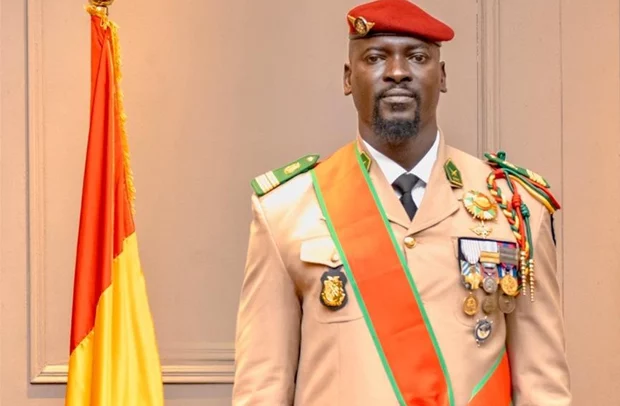
General Mamadi Doumbouya
The Quelling of Dissent: How Military Rule Prevents Course Correction
Even where military governments establish apparently controlled systems, they inevitably suppress the dissent and political competition necessary for identifying and correcting policy failures. Guinea exemplifies this dynamic. After the September 2021 coup, the junta dissolved the main opposition coalition Front National de la Défense de la Constitution (FNDC) in August 2022 and jailed at least three of its leaders. When these leaders were released in May 2023, the regime’s repressive apparatus remained intact, forcing longtime opposition leader Cellou Dalein Diallo into exile.
On July 9, 2024, three opposition members—Oumar Sylla, Mamadou Billo Bah, and Mohammed Cissé—were arrested and taken to a detention facility on Kissa island, where they were allegedly tortured. While Cissé was eventually released, the other two remain disappeared, and their wives filed lawsuits in France against Doumbouya for ordering forced disappearances. This pattern of escalating harassment, arbitrary detention, and violence against critics prevents the opposition oversight necessary for democratic governance.
Burkina Faso under Traoré has followed a similar trajectory. The regime has forcefully crushed dissent and arrested civil society activists, journalists, activists, prosecutors, and judges, with critics unlawfully conscripted into military service. This suppression extends to routine administrative functions: those who would normally audit security expenditures or question military strategies face imprisonment or worse. Without mechanisms for feedback, course correction, or accountability, military governments cannot adapt to changing circumstances or learn from policy failures.
The silencing of dissent also eliminates early warning systems for brewing crises. In democratic systems, opposition parties, civil society organisations, and independent media identify emerging problems, propose alternatives, and mobilise constituencies for change. Military governments systematically dismantle these mechanisms, leaving regimes blind to popular discontent until it explodes in violence or another coup. Support for democracy in Mali declined to only 37.7 per cent after military rule, reflecting how suppression breeds cynicism about all governance systems rather than building support for the military government.
The Path Forward: Building Stability Through Democratic Institutions
The consistent failure of coups across decades and contexts points toward an alternative approach grounded in institutional development rather than military force. Africa has seen 220 of the world’s 492 coup attempts since 1950, demonstrating that military interventions have become normalised responses to governance failures. Breaking this cycle requires addressing root causes rather than symptoms.
Transparency as Foundation: Governments must operate with unprecedented openness regarding resource allocation, decision-making processes, and policy outcomes. Citizens in countries like Guinea and Mali have repeatedly cited corruption and lack of accountability as motivations for initially supporting coups. However, military governments prove even less transparent than their civilian predecessors, operating with fewer constraints and less oversight. Genuine transparency requires independent audit institutions, freedom of information laws with enforcement mechanisms, and protection for whistleblowers who expose wrongdoing.
Accountability Through Multiple Channels: No single accountability mechanism suffices. Effective governance requires electoral accountability through genuinely competitive elections, legal accountability through independent judiciaries that can prosecute official misconduct regardless of rank, parliamentary accountability through robust legislative oversight, and social accountability through active civil society monitoring. All recent coup-affected countries experienced significant declines in Accountability & Transparency subcategories, illustrating how military rule systematically dismantles these safeguards.
Inclusion Across Social Divisions: Many African societies face ethnic, regional, religious, and economic cleavages that military governments typically exacerbate rather than bridge. Burkina Faso’s jihadist insurgency, for example, has complex roots in ethnic tensions between farming and herding communities over land and resources, which generations of autocratic rule (both civilian and military) failed to address. Participation, Inclusion & Equality declined across all recent coup-affected states. Genuine inclusion requires constitutional frameworks that protect minority rights, electoral systems that incentivise coalition-building across social divides, decentralised governance allowing regional autonomy, and equitable resource distribution addressing historical grievances.
Systems Prioritising Citizens: The ultimate test of governance is whether systems serve citizens or elites. Military governments invariably prioritise their own institutional interests and personal enrichment over public welfare. Niger’s new regulation law, securing unrestricted military access to state resources without public procurement regulations, paved the way not only for weapons purchases but also for personal enrichment of new rulers. Democratic systems, while imperfect, provide mechanisms through which citizens can demand responsive governance: competitive elections allowing peaceful leadership change, independent media exposing corruption and incompetence, civil society organisations mobilising constituencies for policy change, and judicial systems protecting individual rights against state overreach.
Conclusion: The Necessary Rejection of Military Solutions
The recent wave of coups across Africa demonstrates with tragic clarity that military force cannot build the stable, prosperous societies coup leaders promise. From Benin’s December 2025 attempt to Guinea-Bissau’s November 2025 success, from Gabon’s “palace revolution” to Niger’s presidential guard takeover, from Burkina Faso’s double coup to Sudan’s descent into civil war, each instance reveals how power seizures exacerbate the institutional weaknesses, economic vulnerabilities, and social divisions they purport to address.
The evidence is overwhelming: coups worsen economic conditions through sanctions, aid suspension, and investor flight; they destroy health and education systems through resource diversion and service disruption; they eliminate accountability mechanisms that could identify and correct policy failures; and they create cycles of instability that make future coups more likely. Military governments’ consistent pattern of broken promises, intensified repression, and personal enrichment reveals that good intentions, where they exist, cannot substitute for legitimate institutions.
Stability in Africa will emerge not through military interventions but through the patient, difficult work of building transparent, accountable, inclusive institutions that make citizens their priority. This requires international support focused on strengthening rather than circumventing state institutions, regional organisations enforcing anti-coup norms through consistent rather than selective sanctions, domestic civil societies given space to organise and advocate, and political settlements addressing underlying grievances through negotiation rather than force.
The choice facing African societies is not between imperfect democracy and military efficiency, but between systems that can self-correct through political participation and systems that suppress dissent while perpetuating the problems they claim to solve. Every coup since 2020 has demonstrated that military rule offers not a solution but merely a more controlled descent into instability. Only by building institutions grounded in transparency, accountability, inclusion, and citizen-centred governance can Africa break free from the coup trap that has undermined development for seven decades. The path to stability runs not through presidential palaces seized at gunpoint, but through the hard work of democratic institution-building that no coup can shortcut.
Source: Eric Akuamoah-Boateng