

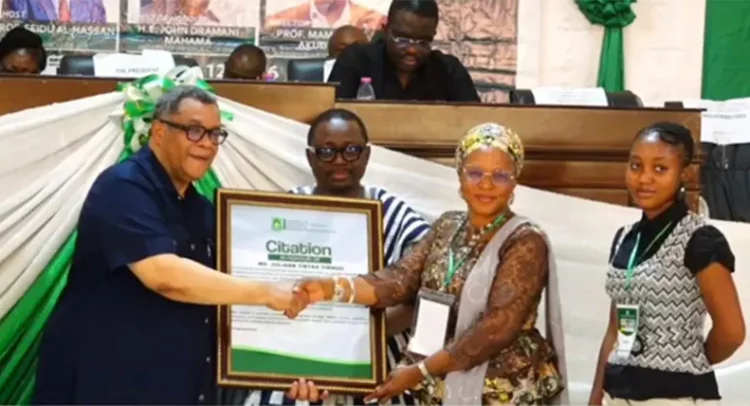
Mr. Goosie Tanoh (L)
The University for Development Studies (UDS) has convened its 20th Harmattan School at Dungu in the Northern Region under the theme: “From Policy to Practice – Implementing the 24-Hour Economy, the Big Push, and MahamaCares.”
The annual event brought together policymakers, academics, and development practitioners to examine the country’s major national initiatives, with a focus on translating policy frameworks into practical outcomes.
Mr Goosie Tanoh, Presidential Adviser on the 24-Hour Economy Programme in the Office of the President, described the Harmattan School as “a breath of fresh air befitting a university that has, since its founding, been preoccupied with the theory and praxis of grassroots socio-economic development.”
He praised UDS for its growing influence on critical issues such as poverty, healthcare, food production, desertification, environmental management, and the climate crisis, not only in northern Ghana but across the continent.
“I think that its twin founders, President Rawlings and Prof. Raymond Bening, both of blessed memory, would have been immensely proud of what UDS and the intellectual community around it have become,” he added.
Explaining the 24-Hour Economy (24H+), Mr. Tanoh said it is an economic transformation programme focused on boosting productivity.
He outlined its guiding principle, indicating that sustained development comes from expanding production, deepening value chains, retaining surplus domestically, and continuously upgrading the productive capacity of the workforce.
“For over a century, our economic structure has been described as the Guggisberg model, which organised around extraction: producing primary commodities for export, importing finished goods, and building infrastructure mainly to move raw materials to the coast.
That model was efficient for its purpose, but it was not designed to maximise domestic value addition, industrial depth, or broad-based productivity,” he explained.
Mr. Tanoh emphasised that the 24-Hour Economy is not merely about longer working hours but about structural transformation: shifting from a corridor-to-port economy to a production-centred, value-retaining model.
“It seeks to expand what Ghana produces, deepen processing, strengthen fair distribution, and ensure more of the surplus generated by Ghanaian labour remains in Ghana to finance national development,” he said.
He revealed that over eight million Ghanaians remain in vulnerable employment – low-productivity, insecure, and difficult-to-scale work – a structural challenge the 24H+ programme aims to address through coordinated action across production, distribution, energy, logistics, and skills development.
The Volta Economic Corridor forms the spatial backbone of the programme, integrating industrial parks, agro-ecological zones, renewable energy systems, and logistics infrastructure from Tema through Akosombo and the Volta Lake to Buipe and Tamale. “Cabinet approval has been secured, with feasibility funding in place. Inland water transport will reduce logistics costs by over 40 percent, decongest major roads, and reconnect north and south Ghana in productive ways,” he noted.
Under the 24H+ framework, a green energy and agro-industrial initiative will deliver 1.5 gigawatts of photovoltaic solar power at Buipe and 500 megawatts of biomass energy, anchored in agro-ecological plantations to strengthen energy reliability and make sustained 24-hour production feasible.
Mr. Tanoh stressed that the programme is privately financed, with the government acting as a catalyst.
“We have learned that Ghana cannot borrow its way into transformation. Private-sector partnerships will drive industrial parks, logistics, agro-processing, power generation, and export platforms,” he said.
Delivering the keynote address, Deputy Minority Leader, Patricia Appiagyei, cautioned that national initiatives – the 24-Hour Economy, the $10 billion “Big Push,” and MahamaCares – risk failure without disciplined planning, broad consultation, and transparent implementation.
“From the North, we demand disciplined hope, not hurried laws or slogans,” she said, urging lawmakers and the executive to consolidate fundamentals before implementing large-scale reforms.
FROM Eric Kombat, Dungu