

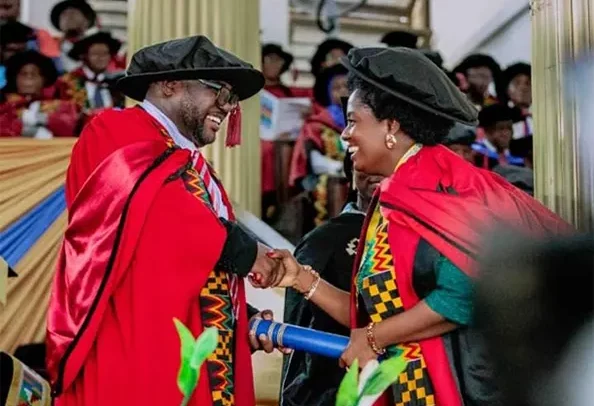
A scene during the graduation ceremony
Former Deputy Minister for Communications, Victoria Lakshmi Hamah, was on Tuesday awarded a Doctor of Philosophy (PhD) degree in Public Administration from the University of Ghana Business School (UGBS).
Her dissertation, titled “Gender Asymmetry in Ghana’s Parliamentary Committees: A Critical Analysis of Women’s Representation and Legislative Influence”, offers a rigorous examination of the institutional and cultural dynamics that shape women’s participation in legislative leadership.
Reflecting on her academic journey on her Facebook page, titled “Humble Recollections: From Storming Seas to the Calm Shore: My Doctoral Journey Through Power and Gender”, Victoria Hamah described earning her PhD as a significant milestone in a journey shaped by her experiences with power, gender, and political scrutiny in Ghana’s public life.
She also noted that her story has often been defined by reductive narratives rather than by the structural realities of women’s leadership in politics.
“The narrative of my public life over a decade, unfortunately, has been reduced to scandal,” she wrote, stressing that such framing is “analytically convenient rather than empirically faithful.”
According to her, the challenges she faced in government were not rooted in incompetence but in a broader political culture that is uncomfortable with women who assert authority without apology. She noted that her appointment as Deputy Communications Minister was accompanied by “sustained challenges to legitimacy that bore little relation to competence or mandate.”
“My body became a site of public scrutiny, my confidence recoded as excess, and my political presence constrained by a culture uneasy with women who occupy power without deference.”
Reflecting on the controversy that later surrounded her time in office, she said the institutional response felt more moralistic than fair, focusing on punishment rather than taking the full context into account.
“When my public controversy emerged, the institutional response was swift, moralistic, and largely indifferent to context,” she wrote, adding that accountability was used selectively while “structural hypocrisy remained uninterrogated,” parts of her post read.
According to her, the incident showed deeper institutional flaws within Ghana’s political system, including “a preference for spectacle over justice, and a willingness to sacrifice women to preserve institutional comfort rather than confront its own contradictions.”
“My departure from office did not signal retreat, but a critical reckoning,” she explained, rejecting the notion that removal from office amounts to erasure. “I turned to systematic inquiry as the continuation of my political engagement through scholarly means,” she added.
Dissertation
Her dissertation examines how “institutional design, political culture, and asymmetrical power relations condition women’s participation and constrain their legislative influence.”
“This work is not autobiographical reflection disguised as scholarship; it is a rigorously grounded political intervention informed by lived experience and sustained empirical analysis,” she pointed out, highlighting her advocacy for women’s empowerment by establishing the Progressive Organisation for Women’s Advancement (POWA), years ago.
By Ebenezer K. Amponsah