
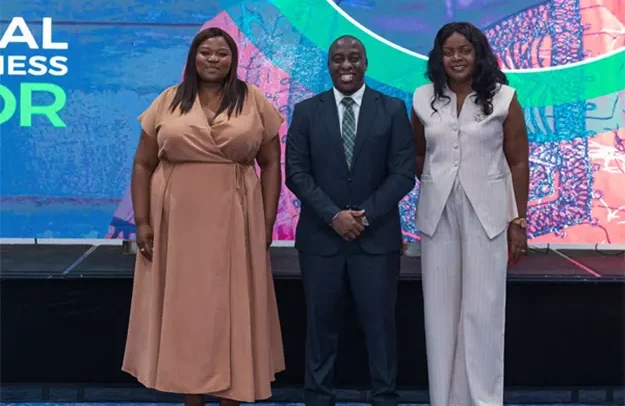
Roy Punungwe with Vuyokazi Madube and Rita Boateng.
Working Ghanaians are emerging from a period of deep financial strain with increasing optimism, improved financial discipline, and reduced stress levels, supported by a stabilising macroeconomic environment, the latest round of the Old Mutual Financial Wellness Monitor (OMFWM) has revealed.
However, the research cautioned that long-term financial vulnerability remains widespread, driven by short-term savings behaviour, low retirement preparedness, and limited access to professional financial advice.
The survey, which focused on urban and peri-urban working Ghanaians aged 20 to 59 earning GH¢1,200 or more, provided insight into financial attitudes, behaviours, and resilience across both the formal and informal sectors.
The report said confidence in the economy had more than doubled, rising from 22 percent to 48 percent, with seven in ten working Ghanaians believing the economy would improve over the next year.
As economic pressures eased, financial stress levels halved, dropping from 60 percent to 30 percent, the lowest level recorded in three years of tracking, the report said.
“After several years of sustained financial pressure, working Ghanaians are finally beginning to experience some much-needed financial breathing room,” said Roy Punungwe, CEO of Old Mutual Group Ghana.
“In a more stable macroeconomic environment, people are becoming more intentional, managing debt prudently, exercising greater control over spending, and actively rebuilding their savings,” he added.
The report, however, noted that more than a third (37 percent) of respondents reported earning more than they did a year ago.
“Despite this, vulnerability remains pronounced, with 39 percent fear losing their income, and nearly half would run out of money within three months if that income stopped.
“To mitigate risk, many Ghanaians are diversifying income streams. More than one in four (27 percent) are ‘poly-jobbing’, combining formal employment with side hustles, freelancing, or after-hours work. Younger Ghanaians are especially affected, reflecting limited job security and employment opportunities,” the report added.
“What the data shows very clearly is that resilience is being built, but it is fragile. Income may be improving, yet too many households remain just one shock away from financial distress,” Punungwe stated.
The Old Mutual Financial Wellness Monitor concluded that Ghana was transitioning from survival to recovery, but noted that sustainable financial wellness would require greater engagement with formal financial solutions, improved financial literacy, and stronger trust in the financial system.
“This research reinforces why Old Mutual exists,” Punungwe said, and added, “Our role is not just to provide financial products, but to build trust, offer guidance, and help working Ghanaians move from short-term resilience to long-term financial security. The optimism is there, with the right support, it can be transformed into lasting wellbeing.”
A Business Desk Report