
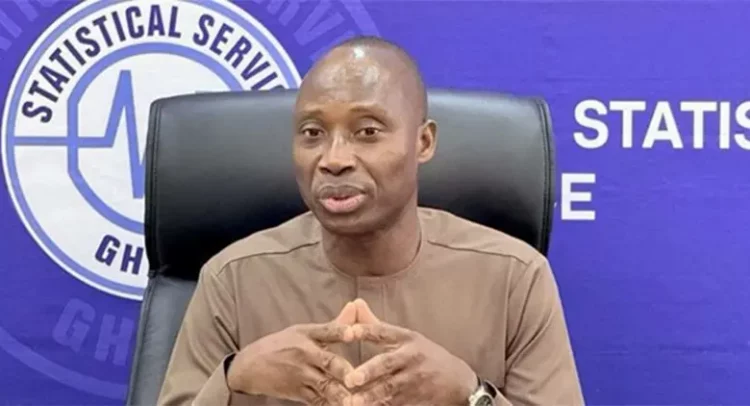
Dr. Alhassan Iddrisu
Multidimensional poverty levels declined in 250 out of 261 districts of the country between 2021 and 2025, according to the Ghana Statistical Service (GSS).
The Government Statistician, Dr. Alhassan Iddrisu, who disclosed this at the launch of the District-Level Multidimensional Poverty Incidence and Rankings Factsheets in Accra yesterday, described the development as encouraging evidence that targeted investments and social interventions were yielding results.
He said the findings represented the first time in Ghana’s history that comparable multidimensional poverty estimates had been produced consistently for all 261 districts over multiple years.
“This tells us that progress is possible. It tells us that investments in education, healthcare, social protection, infrastructure and livelihoods can make a difference,” he stated.
Dr. Iddrisu explained that the new district-level estimates marked a major milestone in the nation’s statistical system and would strengthen decentralised planning, poverty targeting and evidence-based policymaking.
He, however, noted that despite the national progress, poverty reduction remained uneven across the country, with some districts still recording severe deprivation.
According to the report, Yunyoo Nasuan District in the North East Region recorded the highest multidimensional poverty incidence in 2025 at 51.6 percent, while Ayawaso North Municipal in the Greater Accra Region recorded the lowest at 5.5 percent.
The Government Statistician said the more than 46 percentage-point gap between the two districts highlighted persistent inequalities and demonstrated how location continued to shape opportunities and quality of life in Ghana.
He further revealed that the six districts with the highest poverty incidence in 2025 were all located in the North East Region, while poverty generally remained concentrated in parts of the North East, Northern, Oti, Savannah, Upper East, Upper West and Bono East regions.
Dr. Iddrisu said some districts, however, achieved remarkable improvements during the period under review.
He cited Wa West District in the Upper West Region, which reduced multidimensional poverty from 61.9 percent in 2021 to 24 percent in 2025, as the district with the largest improvement nationwide.
Sekyere Afram Plains in the Ashanti Region also reduced poverty significantly from 50.5 percent to 13.5 percent within the same period.
“These districts show that meaningful progress can happen even in places that once faced very high poverty levels. We must study what worked in these districts and apply the lessons elsewhere,” he stated.
The report, however, identified Guan District in the Oti Region as recording the largest increase in multidimensional poverty, rising from 28.1 percent in 2021 to 34.8 percent in 2025.
Dr. Iddrisu stressed that multidimensional poverty went beyond income levels and included deprivation in education, health, housing, sanitation, employment, electricity and access to essential services.
He said the estimates were produced using internationally accepted Small Area Estimation techniques, combining data from the 2021 Population and Housing Census, the 2022–2024 Annual Household Income and Expenditure Survey, and the 2025 Quarterly Labour Force Survey across 13 wellbeing indicators.
The Government Statistician urged Parliament, Metropolitan, Municipal and District Assemblies, development partners, businesses and civil society organisations to use the rankings to guide planning, budgeting and resource allocation.
He announced that individual poverty factsheets for all 261 districts would be made publicly available on the Ghana Statistical Service website immediately after the launch.
By Ernest Kofi Adu