
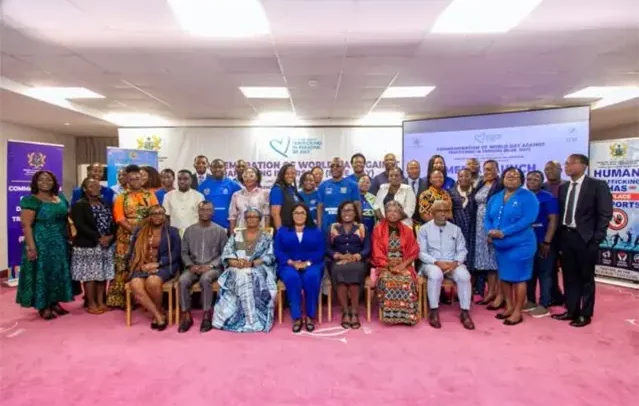
The International Justice Mission (IJM) has called on stakeholders, particularly the government, to make adequate budgetary allocations to the Human Trafficking Fund to strengthen the fight against human trafficking.
Speaking at the media launch ahead of the commemoration of the World Day against Trafficking in Persons, also known as Blue Day, the IJM West Africa Director, Anita Budu, said there is the urgent need for increased awareness, stronger collaboration, and sustainable funding to combat trafficking.
World Day against Trafficking in Persons, commemorated across the world as “Blue Day,” is observed annually on July 30 to raise awareness and combat trafficking in persons.
Madam Budu mentioned that trafficking networks are becoming increasingly sophisticated, exploiting vulnerable people through false promises and digital platforms.
She said this therefore requires adequate funding and collaboration to tackle the issue which is on the rise in recent times.
“IJM is calling for increased funding for anti-human trafficking efforts. That way, we can fund prevention efforts, enable police officers to act, support social workers to care for survivors, support prosecutors to pursue cases, and ensure that survivors are able to rebuild their lives,” she said.
“We will appeal to the government to make adequate allocations to the Human Trafficking Fund and urge institutions, organisations, and individuals to contribute to the fund,” she added.
Madam Budu, however, commended the collaboration between the Ghana Police Service, Interpol, and Nigerian authorities, which led to the rescue of victims trafficked across multiple states in the sub-region.
She further stated that anti-trafficking institutions cannot function effectively without adequate resources.
“As we build up to World Day against Trafficking in Persons, our message is simple: this is the time to act to end human trafficking,” she emphasised.
The Minister for Gender Children and Social Protection, Dr. Agnes Naa Momo also appealed for stakeholder support to help establish border control systems that do not treat victims as criminals.
She also urged the media and Civil Society Organisations to address trafficking in persons in Ghana by partnering with state agencies to sensitise the public about trafficking in persons.
Also present at the launch, organised by the Human Trafficking Secretariat of the Ministry of Gender, Children and Social Protection were heads of government institutions, some Members of Parliament, civil society organizations, Non-Governmental Organisations (NGO’s) and several other dignitaries.
By Ebenezer K. Amponsah