
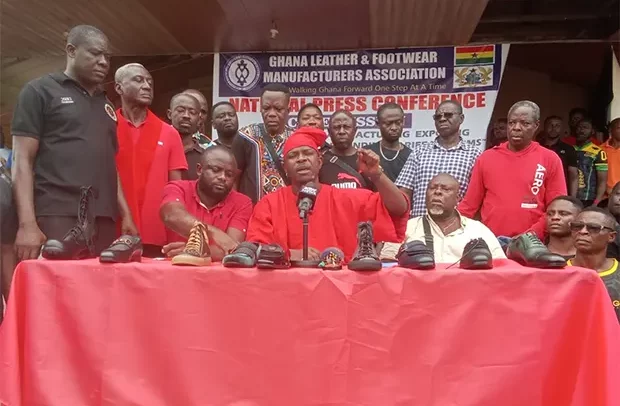
Gilbert Akwasi Ntim (M) addressing the media
The Ghana Leather and Footwear Manufacturers Association (GLFMA) has appealed to government to urgently protect the local footwear industry from the influx of cheap imported shoes from China.
According to the Association, the increasing dominance of foreign footwear on the Ghanaian market is collapsing local businesses, destroying jobs and threatening the survival of the country’s leather industry.
Addressing a press conference on Tuesday, May 26, President of GLFMA, Gilbert Akwasi Ntim, described the situation as “economic sabotage,” insisting that local manufacturers were being treated unfairly compared to importers of foreign footwear.
He disclosed that data from the Ghana Statistical Service (GSS) and UN Comtrade showed that over 70 percent of footwear sold in Ghana between 2024 and 2025 was imported from China, with imports valued at more than $40 million, while Ghana’s footwear exports remained below $1 million.
He noted that several local shoe producers and leather artisans in Kumasi, Accra and Takoradi had either shut down or scaled down operations due to the influx of cheap imported products.
Mr. Ntim lamented that local manufacturers are heavily burdened with taxes on raw materials imported for production.
According to him, although the import duty on some raw materials stands at 10 percent, additional charges under the ICUMS system, including VAT, NHIL and GETFund levies, push the total tax burden to about 36.1 percent before goods are cleared at the ports.
He further alleged that some importers deliberately misclassify finished Chinese shoes as rubber scrap or waste materials in order to evade the legally required 35 percent duty on finished footwear imports.
“This is an inversion of justice. Honest local artisans pay huge taxes on raw materials while smugglers pay very little to import finished products,” he stated.
The Association also raised concerns over the quality and safety of some imported shoes, claiming that certain products bypass safety checks by the Ghana Standards Authority (GSA) due to false declarations at the ports.
The GLFMA is therefore calling on the Ministry of Trade and Industry, the Ghana Revenue Authority (GRA), Ghana EXIM Bank, Ghana Export Promotion Authority (GEPA), Ghana Investment Promotion Centre (GIPC), Parliament’s Select Committee on Trade and the Association of Ghana Industries (AGI) to intervene immediately.
Among the Association’s demands are increased tariffs on imported finished footwear from outside the African Continental Free Trade Area (AfCFTA) zone, a zero percent duty on raw materials used by local manufacturers and access to low-interest loans for industrial machinery.
The Association also wants government to enforce a mandatory local procurement policy requiring the Ghana Armed Forces, Police Service, Immigration Service and public schools to procure footwear from certified local manufacturers.
Mr. Ntim further proposed the introduction of a nationwide “Buy Ghana Made Footwear” campaign to promote locally produced shoes.
He warned that if urgent steps are not taken to save the industry, the Association may withdraw from government trade promotion activities, intensify media engagements and stage peaceful demonstrations to protect local jobs and businesses.
He stressed that Ghana’s footwear industry has the potential to create thousands of jobs and contribute significantly to national economic growth if given the needed support and protection.
FROM David Afum, Kumasi