
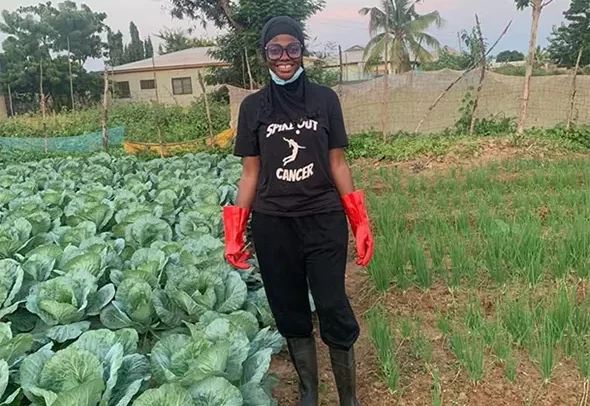
Belawu Abubakari at the farm
Gender Inequality in agriculture across Ghana persists and has contributed to women’s low involvement in the production processes.
In Ghana, access to land remains a major problem because men generally control larger portions of farmlands while the women are offered small portions of lands and in some cases less fertile lands.
These and many more barriers such as unavailability of machinery due to few tractor operations being controlled by men, is limiting women’s ability to expand their farms, prompting women to call for fair access to both land and agriculture machinery.
DAILY GUIDE, visited Belawu Abubakari, a female farmer in the Gushegu Municipality of the Northern region, and she narrated her ordeal as a female farmer.
“I faced tremendous challenges before buying my own farmland. People weren’t willing to lease out their dormant land for me to use, most of them never even took me seriously, they made jokes and laughed when I approached them simply because I am a female,” she lamented.
According to her, she has been faced with stereotypes which almost discouraged her. “Female farmers still face the stereotypes of not belonging to the farm but kitchen. Society makes it as if farming was specifically made and reserved for the male gender. Female farmers do not get enough support, and are always left out in policies pertaining agriculture. The traditional belief is tied to gender roles, females are and should be home makers,” she hinted.
She called for an indiscriminate and gender balanced policies, stressing that female farmers are left with “breadcrumbs” when there is a national resource support for farmers.
“Female farmers make more than half of the national small holder farmers, they should be in important board rooms where policies, initiatives, and decisions are made about agriculture. They should be given not just a voice but equal opportunity to thrive. Farming or agriculture has advanced beyond the old age guess work, it’s a meticulously calculated process and strategy,” she stressed.
She encouraged colleague female farmers not to give up but help contribute to build the agriculture sector in the country.
“Do your research well before venturing in, and start small to scale up later. We feed nations, when next you introduce yourself, say it with a puff chest, I am a farmer,” she urged other female farmers.
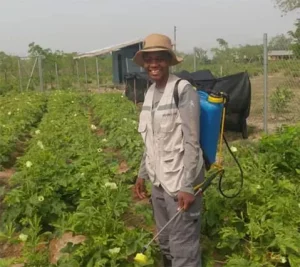
Belawu Abubakari spraying her farm
CSO Perspective
In an interview with DAILY GUIDE, Executive Director for Savannah Women Integrated Development Agency (SWIDA) Ghana, Hajia Alima Sagito-Saeed, said female farmers are significantly affected because they already operate within systems that limit their access to land, credit, extension services, and market opportunities , many inequalities and barriers to access opportunities.
“Any gaps in support whether policy delays, climate shocks, or inadequate services deepens their vulnerability. For women in forest and farm value chains across the Northern, North East, Savannah and Upper East and West Regions, these challenges translate into reduced productivity, higher production costs, limited income and ever widening poverty levels, particularly for women. It ultimately slows their ability to scale their agribusinesses and contribute fully to household welfare and local economies,” she indicated
Hajia Sagito-Saeed stressed that government can take deliberate actions to ensure female farmers thrive.
“First, by improving women’s long-term access to land through gender-responsive land reforms and community sensitisation. Secondly, providing targeted agricultural input support such as climate-resilient seeds, fertilizers, and gender friendly small machinery specifically designed with women’s needs in mind. Strengthening extension services, especially through more female extension officers, is also critical. In addition, the government should create accessible financing schemes for women in agribusiness and strengthen market linkages through aggregation centres and off-taker arrangements.
Finally, policies must prioritise women’s leadership and inclusion in value chain decision-making spaces. These steps align with the work we do at SWIDA Ghana to improve women’s livelihoods and secure their economic justice,” she disclosed.
Hajia Sagito-Saeed further urged female farmers to continue with the good job and never give up because they are leaders, innovators, and essential drivers of Ghana’s development.
“What motivates me about female farmers is their remarkable resilience. Despite limited resources and structural inequalities, they continue to produce food, sustain local markets, and drive economic growth in their communities. At SWIDA Ghana, our direct engagement with more than 450 women’s groups over the past years has shown us that when women farmers are given even minimal support, they achieve extraordinary results. My motivation to them is that they are not just participants in agriculture; they are leaders, innovators, and essential drivers of Ghana’s development. Their strength inspires us to keep advocating, building capacities, and expanding opportunities so that they can thrive with dignity and confidence,” she add.
Sustainable Development Goals
The Sustainable Development Goal 5, on gender inequality talks about achieving gender equality and empower all women and girls. This goal includes targets an end to discrimination and violence against women, eliminate harmful practices like child marriage and female genital mutilation, recognise unpaid care work, and ensure women’s full and effective participation and equal opportunities for leadership.
Again, the Sustainable Development Goal 2, aims to end hunger, achieve food security and improved nutrition, and promote sustainable agriculture by 2030.
FROM Eric Kombat, Gushegu