
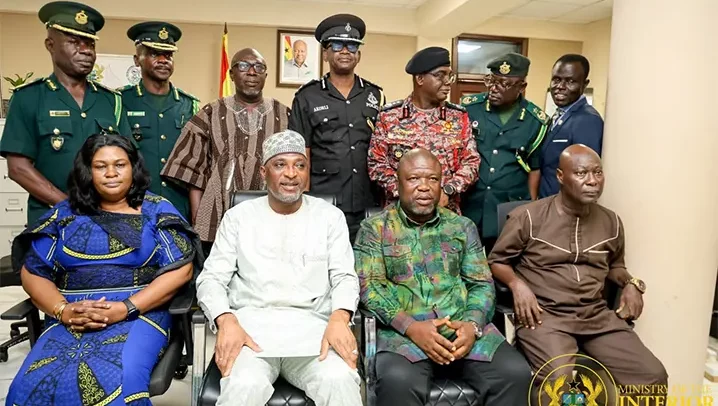
The Interior Minister and Volta Regional Minister with Security officers
The Minister for the Interior and Member of Parliament (MP) for Asawase, Muntaka Mohammed-Mubarak, has raised concerns over the growing threats of human trafficking and drug abuse in parts of the country, warning that the two social vices continue to undermine national security, destroy livelihoods, and jeopardise the future of young people.
He made the remarks as he commenced a two-day working visit to the Volta Region aimed at engaging stakeholders, assessing security and development challenges, and strengthening collaboration to address emerging threats.
Speaking during a courtesy call on the Volta Regional Minister, James Gunu, in Ho, the Interior Minister stressed that effective responses to security challenges require direct engagement with communities and local authorities. He noted that while virtual meetings and regular communication with regional officials are useful, firsthand assessment of conditions on the ground provides critical insights that enable government to develop targeted interventions and make informed policy decisions.
Mr. Muntaka indicated that the visit comes at a crucial time as government undertakes a nationwide mass registration exercise for children between the ages of six and fourteen. He observed that the Volta Region’s numerous border crossing points present unique security and administrative challenges that require close monitoring and continuous engagement with local stakeholders.
According to the minister, the visit will provide an opportunity to interact with traditional authorities, opinion leaders, security agencies and residents to better understand the region’s needs. He added that government also seeks to motivate security personnel serving in the region under its broader reset agenda by boosting morale and assuring them of continued support.
The Interior Minister emphasised that direct observation of development and security concerns would help government make informed decisions on resource allocation and future interventions, including preparations toward the 2027 national budget. He stressed that evidence gathered from the field would strengthen policy discussions and development planning at the national level.
The Volta Regional Minister, James Gunu, reaffirmed his commitment to a three-point development agenda focused on sustaining peace and stability, strengthening the capacities of Metropolitan, Municipal and District Assemblies (MMDAs), and deepening collaboration with Ministries, Departments and Agencies (MDAs) to advance President John Dramani Mahama’s vision for the region.
He commended the strong partnership between the Volta Regional Coordinating Council and the Ministry of the Interior, describing it as a major contributor to the peace and security currently enjoyed in the region.
Mr. Muntaka raised concerns over the growing threat of drug abuse, human trafficking and irregular migration, describing them as major security challenges requiring urgent national attention. He called on religious leaders, traditional authorities and community members to support government efforts to combat crime and protect vulnerable populations.
The minister disclosed that the Ghana Immigration Service rescued 714 victims of human trafficking in 2025 and arrested 103 suspected traffickers during various operations across the country. He revealed that investigations showed all the rescued victims entered Ghana through the Volta Region, particularly through the Aflao and Akanu border corridors, often using unapproved routes. He stressed that the development underscores the need for stronger border surveillance and closer cooperation between local communities and security agencies.
Mr. Muntaka also defended the continued operation of inland security checkpoints, noting that they remain vital in combating trafficking, smuggling, organised crime and potential terrorist threats. He further expressed alarm over the increasing abuse of illicit drugs among young people, revealing that some parts of the Volta Region have become areas of concern for the cultivation and distribution of illegal substances.
The minister appealed to churches, mosques and traditional leaders to intensify public education against drug abuse and trafficking, emphasising that the fight against narcotics and organised crime requires the collective effort of government, security agencies and communities.
From Daniel K. Orlando, Ho