
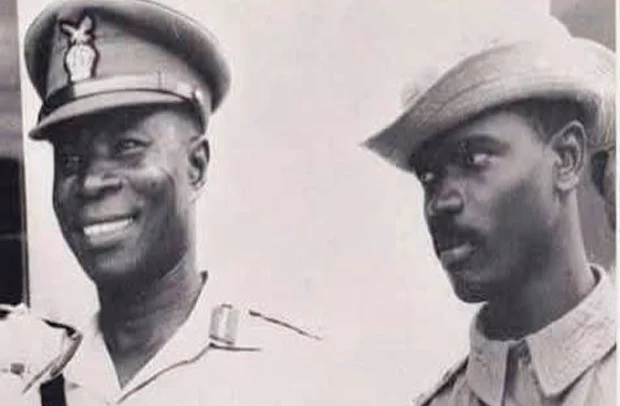
Gen EK Kotoka and Gen AA Afrifa, Colonels at the time of the coup
Last Thursday marked the 60th anniversary of the overthrow of Kwame Nkrumah’s Convention People’s Party (CPP) government.
It was a seismic political development which brought to a close to a one-party state which the country had become.
The putsch took place while Nkrumah was on a state visit to North Vietnam and China, his government was overthrown in a violent coup d’état led by Col EK Kotoka and Col AA Afrifa, with the support of sections of the military and the police. The Chief of the Defence Staff, Major General Aferi was out of the country at the time, and Major General Charles Mohammed Barwah, as Chief of Army Staff at the time, refused to join the coup conspirators, maintaining his loyalty to the government. He was shot along with seven soldiers on guard duty at his residence by Afrifa and his soldiers. Col Gbon Zanlerigu of the Presidential Guard Regiment did not succumb to the coup makers when they descended upon the Flagstaff House. The firefight that ensued raged for several hours between the friendly and enemy forces. Residents in some parts of Nima could hear the reports of the SLRs and SMGs as soldiers carried out orders from their superior officers.
By the time the guns went silent, it was no longer in doubt that Kwame Nkrumah was no longer in charge, the radio broadcast by Col EK Kotoka making it clear.
A National Liberation Council (NLC) junta headed by Lt. Gen. JA Ankrah was established to run the affairs of the country. Nkrumah learnt about the coup only when he landed in China, where he stayed in Beijing for four days.
He was to write later in his book ‘Dark Days In Ghana’ about the involvement of the CIA in the coup, conclusion he drew from a document showed him by Russia’s intelligence and spy agency the KGB.
The coup, some observers noted, was given impetus because of Kwame Nkrumah’s inclination towards the East and Ghana eventually becoming a socialist and one-party state.
He failed to indefinitely suppress political opponents, although he incarcerated some using his repressive Preventive Detention Act (PDA).
Six decades after the event, the schools of thought about the factors leading to the overthrow vary and depend upon the political inclination of those advancing their views on the subject.
Ghanaians had become political conscious, the educational system contributing to this even as economic mismanagement was noticeable.
Perhaps the economic challenges, especially between 1964 and 1965, provided the impetus for the coup conspirators coupled with the CIA support to strike successfully.
Whatever the positions of those engaged in the debate over the merits or otherwise of the military intervention, it is indisputable that on February 24, 1966, most Ghanaians were relieved that a dictatorship had come to an end.
There was an unstoppable and spontaneous gush of people into the streets of Accra as they welcomed the change.
Many headed for the Parliament House where they took part in felling the statue of the first president who, among other nationalists, engaged the colonialists to achieve independence eventually.
Kwame Nkrumah’s appointees were ordered “to report to the nearest police stations for their own safety.”
The gates of the prisons – Ussher Fort and Nsawam – were flung open to let out the hundreds of political prisoners held there.
Most Ghanaians, safe die-hard CPP elements, relished what felt like a new independence. Ghana’s drift to a one-party state was an issue which engaged the minds of many citizens with inclination towards democracy.
It came with the ‘decision’ to make Kwame Nkrumah a life President although at the beginning he appeared unenthused about the proposal.
It all started with a private member’s motion on August 29, 1962 on the floor of Parliament.
Indeed, even before the stage was set for this political development in the country, it had been as a fait accompli that ‘Osagyefo Dr. Kwame Nkrumah will become life-President of Ghana’. This was however conditional upon the adoption of a private member’s motion.
Eight other items were listed for the work of the House on the aforementioned date, but this was overshadowed by the others anyway.
Mr. W.A. Amoro, Member of Parliament (MP) for Bongo, who before the main issue of making Nkrumah life-president, congratulated him on his escape from the Kulungugu bomb and called on Ghanaians to live up to their responsibilities for the maintenance of the security of the nation.
He called on the CPP-dominated House to express confidence on the leadership of Kwame Nkrumah and to associate what he described as a popular desire among Ghanaians that he continue in office as Life President for the remainder of his life.
Another motion which stood in the name of Mr. S.I. Idrissu (Dagomba North), who was a former Ministerial Secretary in the Ministry of Information and Broadcasting, sought to have Ghana become a one-party state.
For whatever reason, Kwame Nkrumah reportedly refused to accept the decision by the National Assembly to become life president. This was to change however with time.
Some critics saw in the refusal a ruse to present Kwame Nkrumah as a man not interested in prolonged power.
In an 80-minute speech during the opening of the third session of the National Assembly on October 3, 1962, Kwame Nkrumah submitted that the most conclusive way to demonstrate a singular support and confidence was by securing the return of “me and my party, the Convention People’s Party, to power at the five yearly elections of Parliament.”
He reminded the MPs that the people had adopted a people’s democracy in which the sovereignty of the people was exercised through Parliament.
Even as he expressed gratitude to the MPs for the motion which, according to him, “was a mark of confidence you have in me, and a unanimous expression of solidarity behind my person and office,” he did not sound at least facially enthused about going as a life president.
This followed Amoro’s private member’s motion which was adopted by the House anyway.
Two years down the lane, things changed and Kwame Nkrumah worked towards Ghana becoming a one-party state.
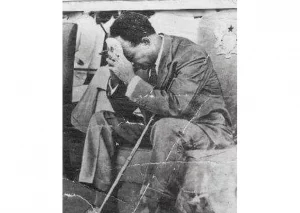
Kwame Nkrumah after his overthrow
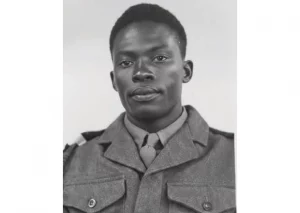
Maj Gen Mohammed Barwah