
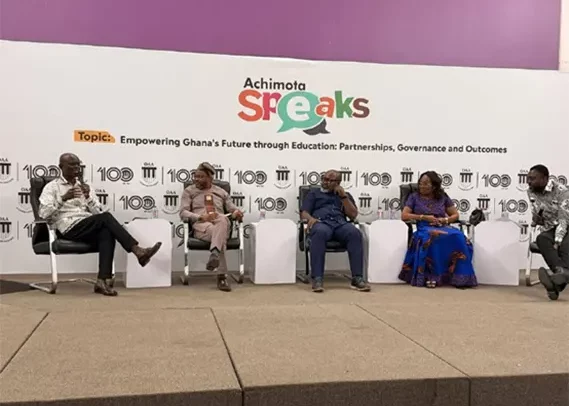
Panelists at the Achimota Speaks Dialogue
Executive Director at Africa Education Watch, Mr. Kofi Asare, has observed that there is an unfair distribution of teachers across the regions of the country.
According to him, some urban areas have more teachers than they need, while rural schools are struggling to get even one teacher, adding that this is a big challenge that needs attention to ensure all students, no matter where they are, get a fair opportunity to learn.
Delivering the keynote address during the ‘Achimota Speaks Dialogue’, Mr. Asare also raised concerns about weak learning outcomes, revealing that a 2024 assessment of Form 2 students across 100 senior high schools showed that only 7% were proficient in English.
He explained that while multiple stakeholders including government, Parents and Teachers Associations (PTAs), alumni groups, and the private sector were contributing to education, their efforts remained fragmented and poorly aligned.
He noted that Ghana’s education system is highly centralised, with government controlling teacher recruitment, curriculum, and financing. While this approach aimed to ensure equity, he said it had instead placed excessive pressure on public finances and limited efficiency.
Another panelist, Frank D. Amponsah-Mensah, Esq., Principal/Head of School at the Ghana International School, stated that teachers were not adequately resourced, compensated, or respected, which affected learning outcomes. He argued that society expected strong results from teachers without investing sufficiently in them.
An education consultant and former headmistress of the Achimota School, Dr. Beatrice Tsotso Adom, also stressed the importance of teacher training and decentralisation, suggesting that schools should have a role in recruiting their own teachers. She added that structured, school-based teacher development programmes were more effective than large-scale centralised training.
By Prince Fiifi Yorke