
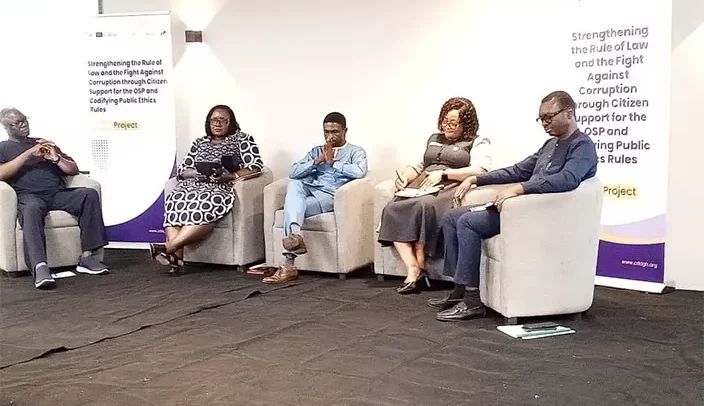
Panelists at the event
As part of its work under the PAIReD Project, the Center for Democratic Development (CDD Ghana), with support from GIZ, has held a national dialogue on the Office of the Special Prosecutor (OSP) to serve as a multi-stakeholder platform with the intent of critically examining the performance, challenges, and future of the OSP as well as build consensus on reforms needed to strengthen its effectiveness and credibility.
The dialogue forms part of a broader initiative aimed at strengthening accountability institutions and enhancing citizen engagement in anti-corruption reforms in Ghana.
Giving brief remarks during the dialogue, the Special Prosecutor, Mr. Kissi Agyebeng, stressed the urgent need to protect and strengthen an independent anti-corruption institution that operates separately from the media and political influence.
He noted that the OSP currently enjoys significant public trust, with many people seeing it as the most credible institution in the fight against corruption.
Reflecting on 2025, he said, “It was our best year of performance, at the same time, it was our worst year of existential troubles,” adding that, “Had there not been the good-naturedness of the president, the office would have been scrapped by the end of December 2025 in Parliament.”
He urged that the OSP be firmly entrenched in the ongoing constitutional review process so that future Special Prosecutors can focus on fighting corruption rather than struggling for the office’s survival.
Speaking at the National Dialogue on the OSP, Team Lead for Governance and Stability, Adams Smith International, Mrs. Linda Ofori-Kwafo, stressed the need to strengthen the legal and institutional framework of the OSP, warning that corruption remains a major national concern.
She cited survey findings showing that 73.9% of Ghanaians believe corruption increased between 2023 and 2024, underscoring public concern over the issue.
According to her, the OSP was established as an independent prosecutorial anti-corruption institution to address the long-standing challenge of the Attorney General prosecuting ministers and other political appointees, given the office’s close ties to the executive.
”The OSP was assessed using the Jakarta Principles for Anti-Corruption Agencies, focusing on five key indicators: permanence, appointment, removal, adequate resources, and public communication,” she mentioned.
Mrs. Ofori-Kwafo noted that, the OSP is only partially compliant on permanence and appointments, because it was created by an Act of Parliament rather than entrenched in the Constitution, making it vulnerable to repeal.
She, therefore, called for stronger constitutional protection to ensure its long-term survival.
She further pointed to resource constraints as a major challenge, saying the office still lacks adequate and reliable resources to effectively carry out its mandate.
Director of Policy Engagement and Partnership, CDD Ghana, Dr. Kojo Asante, during the national dialogue, renewed calls for stronger legal protection and independence for the OSP to enhance the prosecution of politically exposed persons.
According to him, the long-standing challenge has been the inability of the Attorney General, who sits in Cabinet and is appointed by the President, to effectively prosecute serving government officials, especially colleagues within the same administration.
This, he noted, “has often resulted in prosecutions targeting officials of previous governments rather than current office holders.”
However, “the establishment of the OSP in 2018 as a specialised and separate anti-corruption agency has helped remove this limitation, proving that an independent institution can function more effectively,” he said.
Dr. Asante supported the proposals in the constitutional review process to strengthen the OSP, explaining that, this could be done through the creation of an Anti-Corruption Commission and an Ethics Commission.
He stressed that stronger appointment and removal processes, adequate resources, and legal protections are essential to ensure the office remains truly independent and effective in fighting corruption.
The National Dialogue brought together a broad spectrum of stakeholders, including civil society organisations (CSOs), policy makers, development partners, organised professional bodies, media practitioners and influencers, opinion leaders, traditional authorities, youth and women groups to foster constructive dialogue, strengthen collaboration, and develop actionable recommendations to enhance the effectiveness, independence, and operational impact of the OSP.
By Janet Odei Amponsah