
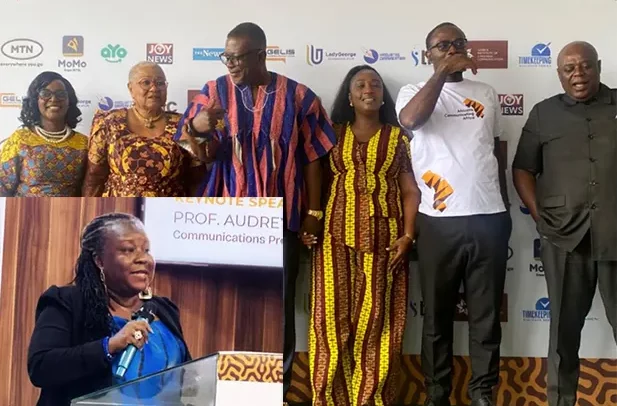
Invited guests at the event. INSET: Prof. Audrey Gadzekpo
The Dean of the School of Information and Communication Studies at the University of Ghana, Prof. Audrey Gadzekpo, has called on African communicators to reclaim the continent’s narrative by telling more balanced and nuanced stories that reflect Africa’s complexity, resilience and humanity.
Speaking at the communicating Africa summit organised by Africans Communicating Africa in Accra, Prof. Gadzekpo stated that the image of Africa has been tainted by the western media in order to justify the plunder of the continent’s resources.
“Western media have manufactured and disseminated the predominant image of Africans as savages in order to justify the exploitation of the continent and the plunder of its resources,” she said.
She again said the negative portrayals of Africa in global media have imposed both psychological and economic costs on the continent over the years.
According to her, persistent reporting on violence, coups, corruption, poverty and instability has created a damaging perception of Africa as a “high-risk investment destination.”
“I recently read a report suggesting that Africa pays as much as $4.2 billion each year in avoidable interest payments simply because of how it’s perceived in global media,” she stated.
Prof. Gadzekpo stressed that while African media must continue to report on governance failures and societal challenges, journalists should approach storytelling with “nuance and context.”
“As communicators, we bear an obligation to increase stories that labour our challenges and hold power to account, but we must tell our stories with nuance. The operative word is nuance and context,” she noted.
Referencing Nigerian author, Chimamanda Ngozi Adichie, and her famous TED Talk, ‘The Danger of a Single Story’, Prof. Gadzekpo warned against reducing Africa to one dominant narrative.
“Single stories flatten complexity, erase difference and tend to reinforce existing power imbalances,” she said, adding that the goal should not be to “pepper over Africa’s faults” but to “multiply stories” from different perspectives.
Prof. Gadzekpo also highlighted the growing opportunities presented by digital media and artificial intelligence in reshaping Africa’s global image.
“A photojournalist in Accra can reach a global audience before a foreign correspondent has filed their first paragraph,” she said.
She explained that artificial intelligence tools could help African journalists with translation, fact-checking, investigative reporting and multimedia production, particularly in under-resourced newsrooms.
However, she cautioned against relying blindly on AI systems trained predominantly on Western data and called for African participation in the development and governance of AI systems, including contributions to training data and algorithmic accountability.
“If we use these tools uncritically, we risk reproducing the very stereotypes we are trying to dismantle. We need to be in the room where these technologies are being shaped and not merely among the populations that are shaped by these technologies,” she added.
Prof. Gadzekpo urged communicators across the continent to use digital platforms, documentaries, podcasts, social media and AI tools to tell stories that reflect “the full weight” of Africa’s diversity and humanity.
“Africa will no longer be merely described. Africa will speak, must speak,” she concluded.
The Executive Director of Salt and Light Ministries, Rev. Joyce Aryee, also encouraged communicators to continue building an inclusive continental community of communicators who are capable of reshaping how Africa is perceived globally.
By Vera Owusu Sarpong