
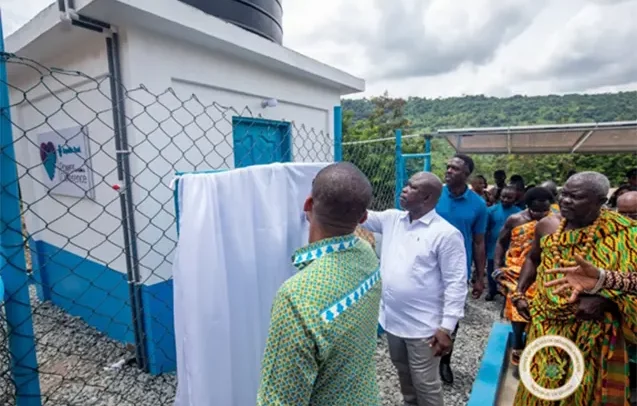
Students and staff of Taviefe Senior High School can now heave a sigh of relief following the commissioning of a mechanised solar-powered borehole by Republic Bank Ghana to address the school’s long-standing water crisis.
The newly commissioned solar-powered borehole is expected to significantly improve sanitation, health conditions and academic performance in the school.
Speaking at the commissioning ceremony, the Volta Regional Minister, James Gunu, commended the bank for supporting the government’s efforts to provide access to clean and safe drinking water in the region.
According to him, the Volta Region continues to face serious water challenges, revealing that the region currently requires about 900 boreholes to meet the growing demand for potable water in schools, health facilities and communities.
“We inherited water crisis in the country and in the Volta Region in particular. Government alone cannot solve the problem, so we need all hands on deck to achieve the United Nations Sustainable Development Goal Six on access to clean drinking water and sanitation by 2030,” he stated.
The Minister disclosed that the government had directed every Metropolitan, Municipal and District Assembly to construct at least 10 boreholes from the District Assemblies Common Fund to help reduce the water deficit.
He further appealed to other corporate institutions and philanthropists to emulate Republic Bank Ghana by supporting communities and institutions facing water challenges.
The Managing Director of Republic Bank Ghana, Dr. Benjamin Dzoboku, stated that the project formed part of the bank’s Corporate Social Responsibility (CSR) initiatives under selected United Nations Sustainable Development Goals, particularly those focused on education, health, sanitation and access to potable water.
“Today is a special day in the life of Republic Bank Ghana because we are making a meaningful difference in the lives of people. Water is life, and access to clean water must not be a struggle,” he said.
Dr. Dzoboku encouraged students to remain focused and determined in life, drawing spiritual lessons from the importance of water.
The Headmaster of Taviefe Senior High School, Sadrack Kwame Abiwu, described the water situation in the school as a major challenge over the years due to the school’s location on a hilly terrain.
He expressed gratitude to the bank and the Regional Minister for fulfilling their promise to provide the facility with the borehole within three months.
“In fact, the challenge of water has affected the school for a very long time. Students used to leave campus with buckets in search of water in nearby communities. We believe this intervention will improve academic performance and the health conditions of both staff and students,” he said.
The Headmaster assured the donors that the school would maintain the facility to ensure its sustainability.
Despite the intervention, Mr. Abiwu appealed to old students, NGOs and philanthropists to support the school with furniture, beds and other essential infrastructure.
According to him, many classrooms lack desks and chairs, compelling students to use dining hall benches during lessons, while inadequate beds continue to affect boarding students.
Some students who spoke during the ceremony also expressed excitement over the intervention, describing the water shortage as one of the greatest challenges confronting the school.
A final-year student, Forgive Hoga, said the water crisis had negatively affected academic work and the health of students.
“We had to walk long distances before getting water to bath and drink. Sometimes we reported late to class and even meals delayed because there was no water for cooking. But now things will change,” the student said.
She indicated the provision of the borehole will reduce illnesses associated with poor access to water and give students more time to focus on their studies.
The mechanized solar-powered borehole is expected to provide reliable water supply for students, staff and the surrounding school community while improving sanitation and overall living conditions on campus.
From Daniel K. Orlando, Ho